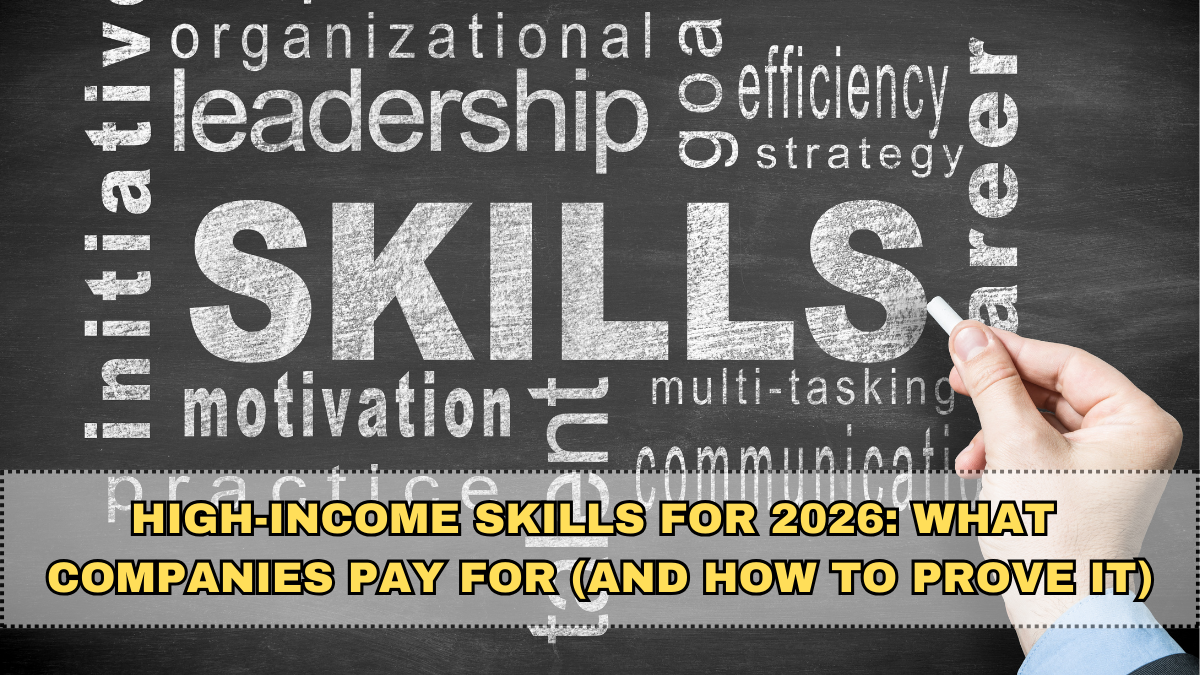
“Learn AI” is not a career plan. In 2026, pay follows applied capability, not buzzwords. The market rewards people who can ship outcomes, integrate tools into workflows, and show evidence. This is why the conversation around high-income skills 2026 has shifted from “what to learn” to “what you can prove.”
This guide cuts through hype and shows the skills employers actually pay for—plus the proof you need to command higher compensation.
What Makes a Skill “High-Income” in 2026
Income correlates with leverage, not novelty.
High-income skills share four traits:
• Direct impact on revenue, cost, or risk
• Measurable outcomes
• Transferable across industries
• Scarcity at the applied level
If a skill can’t be tied to outcomes, it won’t scale your pay.
AI Skills That Actually Pay (Beyond Prompting)
Generic prompting is commoditized. Applied AI isn’t.
What pays:
• Workflow automation with AI tools
• Model-assisted analysis (not model building)
• AI evaluation and QA
• AI integration into existing systems
AI skills earn when they save time or money at scale—not when they generate demos.
Data Skills: Practical Beats Theoretical
Data continues to pay because decisions still need evidence.
High-value data abilities:
• Business analytics with clear KPIs
• Dashboarding for decisions (not vanity charts)
• Data cleaning and validation
• Translating data into actions
You don’t need a PhD—just the ability to answer real questions.
No-Code & Automation: The Quiet Money Skill
No-code is misunderstood as “easy.” It’s not.
Why it pays:
• Faster delivery than engineering-only teams
• Lower maintenance costs
• Rapid iteration for ops and growth
What matters:
• System design
• Edge cases
• Reliability
No-code pays when you replace manual work, not when you build toys.
Marketing Skills That Survived AI
AI didn’t kill marketing—it raised the bar.
High-income marketing skills in 2026:
• Demand generation strategy
• Conversion optimization
• Lifecycle email systems
• Paid acquisition with ROI discipline
Tools change weekly. Strategy still pays.
Product & Ops Skills Companies Pay Premiums For
Execution gaps are expensive.
High-income ops/product skills include:
• Process optimization
• Cross-team execution
• Metrics definition
• Tool stack rationalization
These skills compound because they multiply team output.
Cyber, Privacy, and Risk Skills (Underrated but Lucrative)
As automation spreads, risk rises.
What’s in demand:
• Security operations basics
• Privacy-by-design implementation
• Compliance mapping
• Incident readiness
Companies pay more to avoid disasters than to chase growth.
How to Choose ONE Skill (Don’t Stack Randomly)
Random stacking leads to shallow competence.
Choose based on:
• Your existing background
• Market demand you can access
• Proof you can build in 60–90 days
Depth beats breadth for high-income skills 2026.
How to Prove a Skill (This Is Where Most Fail)
Certificates don’t convince. Proof does.
Effective proof includes:
• Case studies with metrics
• Before/after comparisons
• Live projects or demos
• Clear problem → action → result narratives
If you can’t show impact, you can’t price high.
Proof Ideas That Work Without a Job
You don’t need permission to prove value.
Examples:
• Automate a real workflow and document savings
• Rebuild a public dataset into insights
• Optimize a funnel and publish results
• Ship a small tool others can use
Public proof beats private claims.
What NOT to Chase (Even If It’s Trending)
Avoid skills that:
• Depend on a single platform
• Have zero outcome ownership
• Are easily copied
• Are hype-driven
Trends fade. Leverage lasts.
Pricing Your Skill: Why Hourly Caps You
High-income skills escape hourly ceilings.
Better pricing models:
• Project-based
• Outcome-based
• Retainer with deliverables
Charge for impact, not time.
Where People Underestimate Themselves
Common traps:
• Waiting for mastery before charging
• Under-communicating results
• Comparing to top 1% online
• Discounting operational wins
If it moved a metric, it has value.
How Long It Takes to Become “High-Income”
Reality check:
• 30 days: fundamentals
• 60 days: first proof
• 90 days: credible offers
• 6–12 months: compounding returns
Speed comes from focus, not shortcuts.
Conclusion
The winners in high-income skills 2026 aren’t chasing buzzwords—they’re building leverage. AI, data, no-code, marketing, and ops all pay when tied to outcomes and backed by proof. Pick one lane, go deep, build evidence, and price for impact.
High income isn’t about knowing more. It’s about making things work better—and showing it.
FAQs
What are high-income skills in 2026?
Skills that drive measurable business outcomes—AI integration, data analytics, automation, marketing strategy, and ops.
Do I need coding to earn high income?
No. Many high-income roles focus on integration, analysis, and execution rather than coding.
How do I prove skills without a job?
Ship projects, document results, publish case studies, and show before/after metrics.
How long does it take to earn more with a new skill?
With focused effort, proof can be built in 60–90 days; income compounds over months.
Should I learn multiple skills at once?
No. Depth in one skill outperforms shallow stacks.