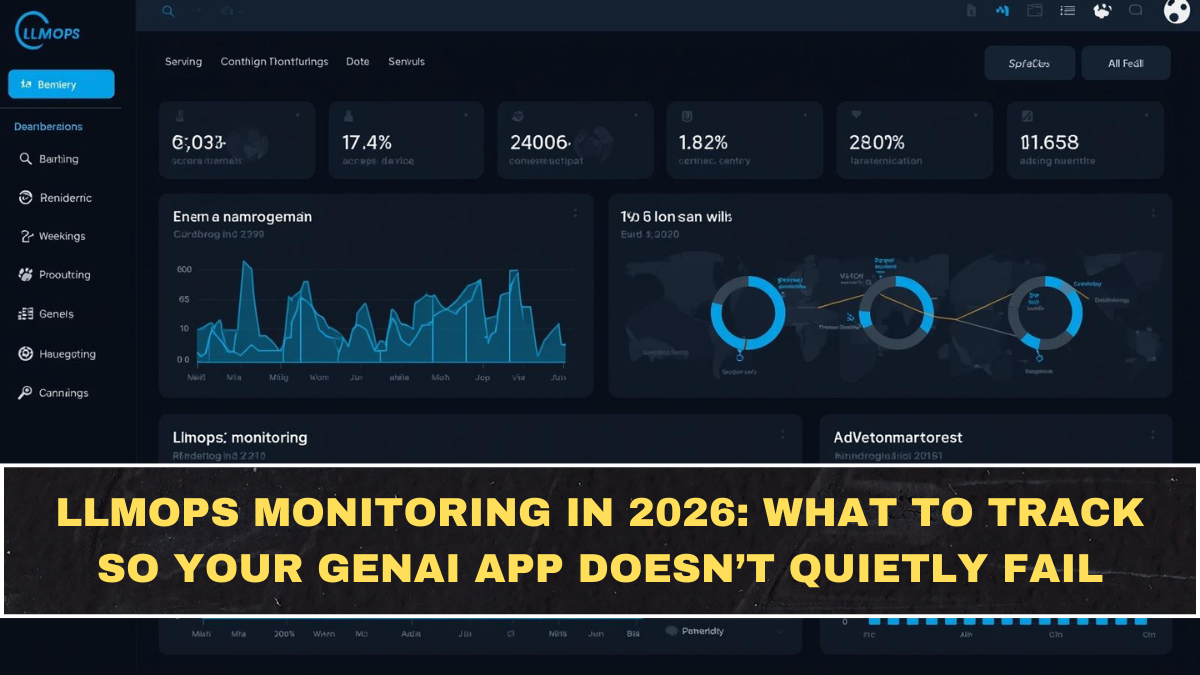
By 2026, most GenAI applications are no longer failing loudly. They are failing quietly. Outputs look fine at a glance, systems stay online, and dashboards remain green, yet something is off. User trust erodes, costs creep up, and quality degrades slowly until the product is blamed instead of the model. This is the exact failure mode LLMOps monitoring is meant to prevent.
LLMOps monitoring is not about watching logs or counting tokens in isolation. It is about maintaining visibility into how AI systems behave over time, under real usage, and at real scale. Teams that treat monitoring as a first-class discipline catch problems early. Teams that ignore it discover issues only after users complain or costs explode.
Why LLMOps Monitoring Matters More Than Ever
Early GenAI deployments focused on getting something to work. Monitoring came later, if at all. As systems scaled, this gap became dangerous. Models that perform well in testing often degrade subtly in production.
User behavior changes, prompts evolve, and data distributions shift. Without monitoring, these changes go unnoticed until they cause measurable harm. In 2026, silent failure is the most common AI risk.
LLMOps monitoring exists to surface weak signals before they become incidents.
The Core Metrics Every Team Must Track
Effective LLMOps monitoring starts with a small set of core metrics. Cost, latency, quality, and reliability form the baseline. Tracking everything creates noise, while tracking nothing creates blind spots.
Cost metrics show how usage patterns evolve and where inefficiencies emerge. Latency metrics reveal whether systems remain responsive under load. Quality metrics indicate whether outputs still meet expectations.
In 2026, disciplined metric selection matters more than dashboard complexity.
Why Cost Monitoring Is Not Optional
GenAI costs behave differently from traditional infrastructure costs. They scale with usage, prompt length, and response complexity. Small changes in behavior can double spending overnight.
Teams must monitor cost per request, cost per user, and cost trends over time. Without this visibility, budget overruns are discovered too late to correct gently.
Cost monitoring turns financial surprises into manageable decisions.
Latency as a User Trust Signal
Latency is not just a performance metric; it is a trust signal. Users interpret slow responses as unreliability, even when outputs are accurate.
Monitoring average latency is not enough. Teams need to track tail latency, spikes, and degradation patterns during peak usage.
In 2026, perceived speed is part of product quality, not a technical afterthought.
Tracking Output Quality Over Time
Quality is the hardest thing to monitor because it is not a single number. It includes correctness, relevance, tone, and safety.
Teams use a mix of automated checks and sampled human reviews to track quality trends. The goal is not perfect accuracy, but early detection of drift.
LLMOps monitoring treats quality as a moving target, not a static achievement.
Understanding Prompt and Behavior Drift
Prompts are code, and code changes introduce risk. Prompt drift occurs when small updates accumulate and alter system behavior unexpectedly.
Monitoring prompt versions and correlating them with quality or cost changes is essential. Without version awareness, teams cannot explain why performance shifted.
In 2026, prompt observability is a core LLMOps capability.
Detecting Data and Context Drift
Many GenAI systems rely on retrieved or contextual data. When that data changes, model behavior changes too.
Monitoring input distributions, retrieval hit rates, and context relevance helps detect drift early. These signals often precede output quality issues.
Ignoring input drift is one of the fastest ways to lose system reliability.
Alerts That Trigger Action, Not Panic
Good monitoring does not flood teams with alerts. It defines thresholds that matter and links them to clear actions.
Alerts should answer three questions: what changed, why it matters, and what to do next. This turns monitoring into decision support.
In 2026, alert fatigue is treated as a monitoring failure, not a user problem.
Incident Playbooks for GenAI Systems
When something goes wrong, teams need predefined responses. Incident playbooks describe how to investigate, mitigate, and communicate issues.
These playbooks reduce confusion and speed up recovery. They also create learning loops through post-incident reviews.
Preparedness transforms incidents from crises into improvements.
Why Monitoring Is a Governance Requirement
LLMOps monitoring supports governance by creating traceability and accountability. It shows that systems are being watched, measured, and adjusted responsibly.
Organizations increasingly need to demonstrate that AI behavior is understood and controlled. Monitoring provides that evidence.
In 2026, monitoring is both an engineering practice and a trust signal.
Conclusion: Visibility Is the Real LLMOps Advantage
LLMOps monitoring is not glamorous, but it is decisive. Teams that see clearly make better decisions, react faster, and ship with confidence.
GenAI systems rarely fail all at once. They drift, degrade, and surprise. Monitoring turns these surprises into signals.
In 2026, the strongest GenAI products are not the smartest ones. They are the ones that are watched closely enough to stay reliable.
FAQs
What is LLMOps monitoring?
It is the practice of tracking cost, latency, quality, and behavior of GenAI systems in production.
Which metrics matter most for GenAI apps?
Cost, latency, output quality, prompt changes, and drift indicators are the core metrics.
Is manual review still needed for monitoring?
Yes, sampling outputs periodically helps detect issues automated metrics may miss.
How often should prompts be monitored?
Continuously, especially after changes or when usage patterns shift.
Do small teams need full LLMOps monitoring?
Yes, even lightweight monitoring prevents silent failures and cost surprises.
Is monitoring part of AI governance?
Yes, it provides evidence of responsible oversight and operational control.