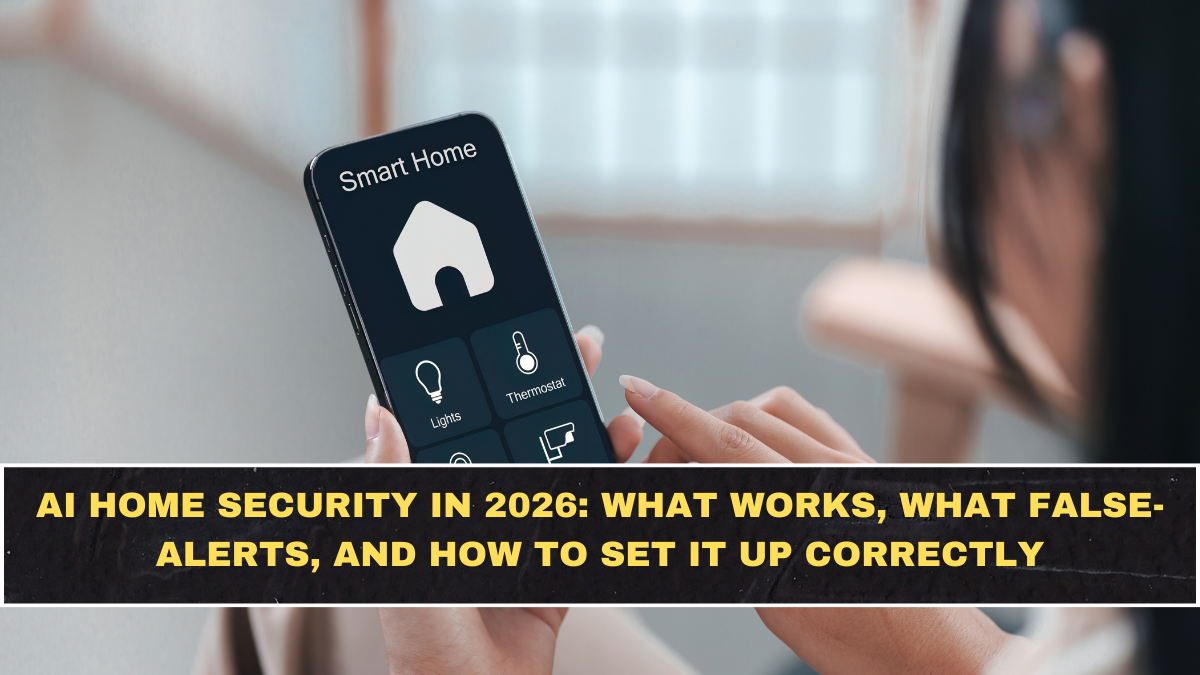
AI-powered home security in 2026 promises smarter detection, fewer false alarms, and better peace of mind. Cameras can now distinguish between people, pets, vehicles, and movement patterns instead of reacting to every shadow or passing leaf. For many households, this sounds like the end of constant notification fatigue and unreliable alerts.
The reality is mixed. AI home security works well when configured carefully, but it becomes unbearable when treated as a plug-and-play solution. False alerts, privacy concerns, and overconfidence in automation still cause many systems to be disabled within months. In 2026, success depends less on buying advanced hardware and more on how detection logic is set up.
What AI Home Security Actually Does Well in 2026
AI security systems are genuinely better at classification than earlier motion-based setups. Identifying humans versus animals has improved significantly, reducing unnecessary alerts caused by pets or wildlife.
Facial and object recognition also help prioritize alerts. Systems can flag unfamiliar faces or unusual behavior patterns rather than reacting to routine movement.
When used correctly, these improvements reduce noise and help users respond only to meaningful events.
Why False Alerts Still Happen So Often
False alerts persist because AI systems are trained broadly, not specifically for your home. Environmental factors like lighting changes, reflections, rain, or camera angles still confuse models.
Another cause is overly sensitive settings. Many users leave default detection thresholds unchanged, leading to constant triggers.
In 2026, most false alerts are configuration failures, not AI failures.
The Most Common Setup Mistakes People Make
One common mistake is placing cameras without considering movement paths. Cameras pointed at busy streets, trees, or reflective surfaces generate constant alerts.
Another mistake is enabling every detection category. When systems try to detect everything, they often fail to prioritize anything.
Ignoring activity zones is also costly. Without defined zones, AI has no context for what matters.
How to Set Detection Rules That Actually Work
Effective setups start with narrowing focus. Define specific zones where human movement matters, such as entrances and access points.
Adjust sensitivity gradually. Lower sensitivity often improves accuracy by filtering out minor motion.
Review alerts for a few days and refine rules based on real behavior. AI improves when given cleaner signals.
Balancing AI Security With Privacy at Home
AI security requires data processing, often in the cloud. This raises concerns about who can access footage and how long it is stored.
In 2026, many systems offer local processing options that reduce data sharing. Choosing these settings improves privacy without sacrificing functionality.
Transparency matters. Households should know when cameras are active and what is being recorded.
Where AI Security Adds Real Value
AI security adds the most value at entry points. Doors, gates, and garages benefit from focused detection.
It is less effective for general indoor monitoring, where normal activity creates too much variation.
Targeted use produces better results than blanket coverage.
Why AI Cannot Replace Common Sense
No system understands intent. AI detects patterns, not motives. A familiar face behaving unusually may still require human judgment.
Relying entirely on automation creates blind spots. AI should support awareness, not replace it.
In 2026, human oversight remains essential for security decisions.
Costs, Subscriptions, and Hidden Trade-Offs
Many AI security features are locked behind subscriptions. Facial recognition, extended storage, and advanced analytics often require ongoing fees.
Users should evaluate whether these features provide daily value or just occasional reassurance.
In some cases, simpler setups deliver similar peace of mind without recurring costs.
Who Should Invest in AI Home Security
Homes with frequent deliveries, shared access, or higher security needs benefit most from AI-enhanced systems.
For low-risk households, basic monitoring may be sufficient. Over-securing can lead to alert fatigue.
Matching security level to actual risk improves satisfaction and long-term use.
Conclusion: Smart Security Needs Smart Setup
AI home security in 2026 works when treated as a configurable system, not a magic shield. Accurate detection depends on placement, sensitivity, and thoughtful rules.
False alerts are not inevitable. They are usually signs of rushed setup or unrealistic expectations.
When configured carefully, AI security fades into the background and delivers what people actually want: awareness without anxiety.
FAQs
Does AI home security eliminate false alerts completely?
No, but proper configuration significantly reduces them compared to basic motion systems.
Is AI security safe for indoor use?
It can be, but privacy considerations are important, especially in shared living spaces.
Do AI security systems need subscriptions?
Many advanced features require subscriptions, so buyers should check ongoing costs.
Where should AI cameras be placed for best results?
Entry points and access areas provide the most reliable detection with minimal noise.
Can AI security work without internet?
Some local processing features work offline, but cloud-based alerts may stop temporarily.
Is AI home security worth it in 2026?
Yes, when configured correctly and matched to real security needs rather than fear.