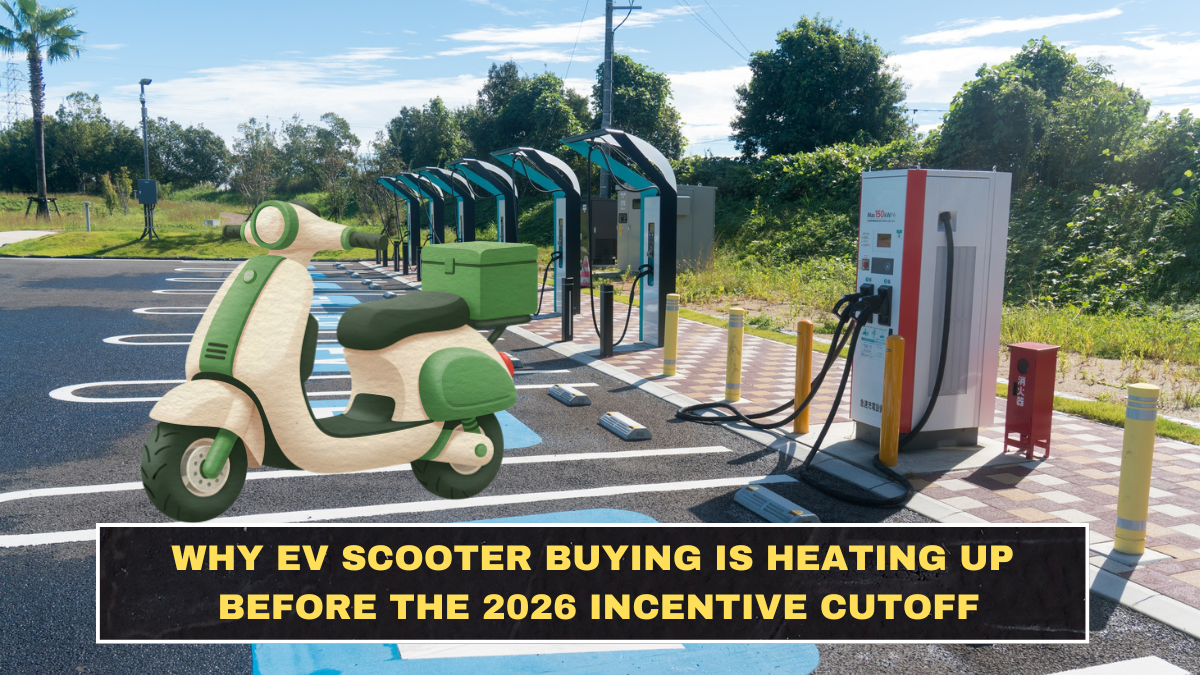
Nothing pushes buyers faster than the fear of paying more later. That is exactly what is happening in India’s EV scooter market right now. For months, the big trigger was the expected March 31, 2026 subsidy deadline under PM E-DRIVE. Buyers rushed to lock in lower effective prices, and brands piled on discounts to convert that urgency into sales.
But here is the twist many lazy articles will miss: the story changed on March 27, 2026. The official PM E-DRIVE portal now says the scheme has been extended for e-2Ws till July 31, 2026. So the original hard March-end cutoff has shifted, but the urgency has not vanished. It has simply changed shape.
That is why EV scooter buying is still heating up. The market now has a mix of deadline psychology, year-end discounts, and tighter subsidy rules, all hitting at the same time.
What PM E-DRIVE Actually Means for EV Scooter Buyers
PM E-DRIVE is the central government scheme meant to support EV adoption through incentives, charging infrastructure, and manufacturing support. PIB said the scheme had an outlay of ₹10,900 crore and originally ran from October 1, 2024 to March 31, 2026, with ₹1,772 crore earmarked for incentivising 24,79,120 electric two-wheelers.
That matters because EV scooter pricing in India is still sensitive. A subsidy does not magically make all products cheap, but it can make the difference between “maybe later” and “buy now” for a price-conscious buyer. That is why deadline talk affects demand so quickly.
Here is the cleaner version of what changed:
- the old e-2W terminal date was March 31, 2026
- the scheme itself had already been extended to March 31, 2028 for broader components
- now, the official portal says e-2W incentives are extended till July 31, 2026
Why Sales Jumped Before the Deadline
The sales surge is not imagined. Times of India reported that by March 27, 2026, India’s electric two-wheeler sales had already reached 1.39 lakh units for the month, beating March 2025’s 1.31 lakh and nearing the earlier peak of 1.45 lakh in October 2025. The same report said FY26 e-2W sales were up 17% year on year, reaching 1.35 million units versus 1.15 million in FY25.
That spike came from three forces working together:
- buyers wanted to beat the perceived subsidy deadline
- brands launched aggressive offers and price promotions
- more legacy manufacturers improved distribution and product availability
So no, this was not just “green awareness.” It was pricing pressure and deadline behavior doing what they always do in India: forcing delayed buyers to move.
The Deadline Has Shifted, but the Pressure Has Not
A lot of people will now assume the heat goes away because the subsidy has been extended to July 31, 2026. That is too simplistic. Economic Times reported today that the Centre has also tightened guidelines and introduced stricter eligibility deadlines and caps for electric two- and three-wheelers. ETAuto similarly reported tighter unit and price limits around the scheme.
That means the market is not moving from urgency to comfort. It is moving from one kind of urgency to another.
The practical message for buyers is this:
- yes, there is more time than expected
- no, that does not mean incentives are now casual or unlimited
- brands may still use the extension window to push promotional sales hard
| Issue | What was true before | What is true now |
|---|---|---|
| Expected e-2W subsidy end | March 31, 2026 | Officially extended to July 31, 2026 |
| Market reaction | Buyers rushed to beat March-end cutoff | Demand may stay elevated during the extension window |
| Scheme conditions | Broader support framework already in place | Rules are getting tighter with caps and stricter eligibility |
Who Is Benefiting From the Rush
The latest market data shows the winners are not all the same brands people assumed a year ago. Times of India said TVS crossed 3.3 lakh units in FY26 and became the first to cross 3 lakh annual e-2W sales, while Bajaj hit 2.76 lakh, Ather rose to 2.3 lakh, and Hero MotoCorp nearly tripled sales to 1.39 lakh. Meanwhile, Ola Electric saw a sharp drop to 1.61 lakh from 3.44 lakh in the prior year period, and responded with aggressive offers through March-end.
That tells you something important. Subsidy-led demand is helping the market, but it is not helping everyone equally. Brands with stronger distribution, more trust, and better execution are using this window better than brands that relied mainly on hype.
What Buyers Should Actually Watch
Do not make the stupid mistake of thinking subsidy timing is the only thing that matters. It matters, but it is not the whole deal. Mint reported recently that e-two-wheeler adoption is still modest relative to the overall segment, rising only from 6.1% in 2024 to 6.3% in 2025, which means this market is still sensitive to pricing, margins, and execution.
So if you are evaluating an EV scooter, the real checklist is:
- final on-road price after all incentives and offers
- service network and delivery reliability
- battery warranty and practical usage fit
- whether the current scheme eligibility still applies to your model
Conclusion
EV scooter buying is heating up because subsidy deadlines still change buyer psychology even when the deadline moves. India’s market saw a strong March 2026 surge as buyers rushed to beat the old March-end PM E-DRIVE cutoff, and now the official extension to July 31, 2026 gives the market a second urgency window rather than a cooldown.
The blunt reality is this: subsidy-driven buying is not about ideology. It is about price. And in a market where price still heavily shapes EV adoption, even a few months of extra incentive support can pull forward a lot of demand. Buyers should stop pretending there is no rush, and brands should stop pretending subsidies do not matter. They clearly do.
FAQs
Is the EV two-wheeler subsidy in India ending in March 2026?
It was widely expected to end on March 31, 2026, but the official PM E-DRIVE portal now says e-2W incentives have been extended till July 31, 2026.
Why did EV scooter sales jump in March 2026?
Recent reporting says the spike was driven by subsidy-deadline urgency, strong brand promotions, and broader distribution gains.
Does the extension mean buyers can relax now?
Not really. The scheme continues, but recent reporting says the Centre has tightened deadlines and capped incentives more strictly, so the market is still under pressure.
Which brands are leading the EV scooter market now?
Recent March 2026 reporting shows TVS leading, followed by Bajaj, Ather, and Hero MotoCorp, while Ola Electric has slipped sharply from its earlier levels.