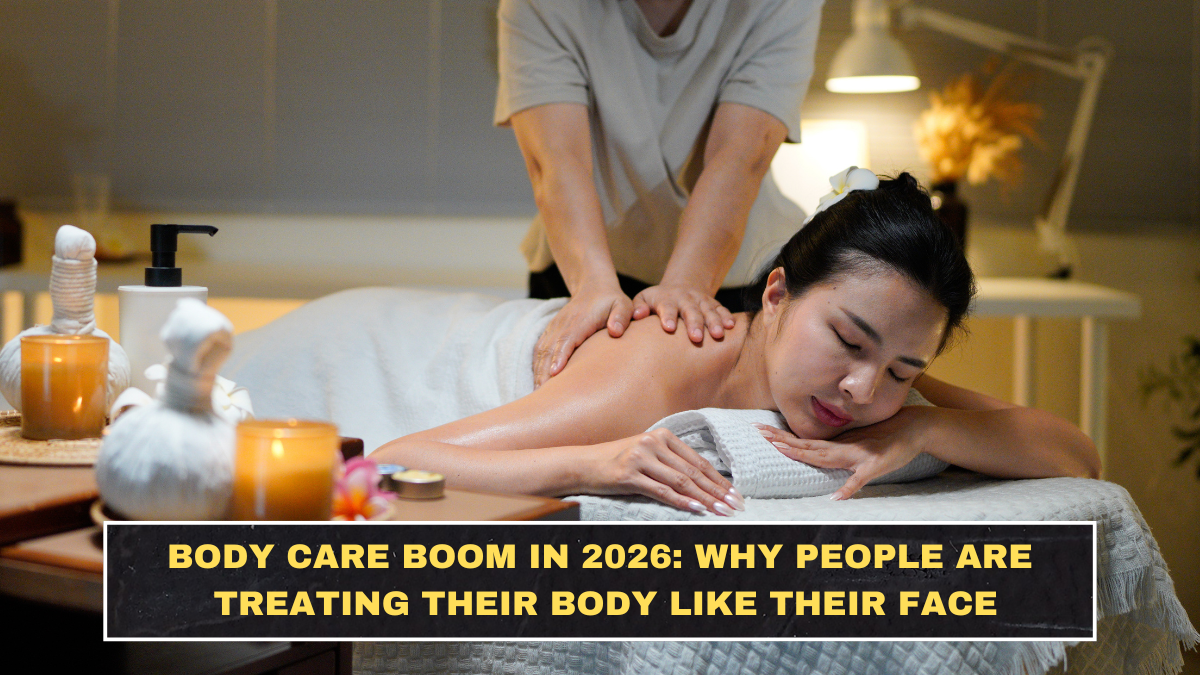
Body care is growing because people have stopped treating the body as an afterthought. For years, many consumers spent heavily on face serums, acids, barrier creams, and retinoids, then used the cheapest body wash and lotion they could find. That split is breaking down. Mordor Intelligence estimates the body care products market at $81.23 billion in 2026, up from $77.18 billion in 2025, and projects it could reach $103.61 billion by 2031. NielsenIQ also reported that beauty sales grew 10% over the prior 12 months in its 2025 State of Beauty report, showing the wider category still has strong momentum.
The reason is not complicated. Consumers now understand that the skin on the body also deals with dryness, roughness, irritation, acne, discoloration, and barrier damage. Vogue’s March 2026 trend report described this as body care having its “skin-care moment,” with ingredients like ceramides, peptides, exfoliating acids, and retinol moving below the neck. That is the real shift: body care is no longer being sold only as softness or fragrance. It is being sold as treatment.

What has changed in how people think about body skin?
People are finally recognizing that body skin has real needs, not just cosmetic ones. A 2025 review on skin barrier science explains that the epidermal barrier is essential for preventing water loss and protecting against irritants. When that barrier is disrupted, skin becomes more vulnerable to dryness, inflammation, and sensitivity. That basic science helps explain why barrier-focused body care has grown so fast: consumers are hearing more about ceramides, gentle cleansing, and moisturization because those ideas actually connect to how skin works.
Dermatology advice supports the same direction. The American Academy of Dermatology says moisturizer plays a key role in healing dry skin and recommends applying it after bathing while the skin is still damp. Harvard Health also notes that thick creams and ointments remain the first line of defense for dry, eczema-prone skin. So while beauty brands love calling this a new ritual, part of the trend is simply consumers catching up to very old skin-care logic.
Why are body serums, shower oils, and treatment products getting more attention?
Because they solve more specific problems than old-school lotion alone. Body serums are being positioned for tone, texture, breakouts, and roughness. Retinol body products are getting attention for uneven tone, crepey texture, and keratosis pilaris, while salicylic-acid and exfoliating body products are being pitched for body acne and rough bumps. Vogue’s 2026 body-care report specifically called out retinol body products, serum body washes, and body milks as standout trends, while dermatology-oriented trend reporting has also pointed to niacinamide, retinol, and salicylic acid showing up more often in body products.
Shower oils and gentler cleansers are also rising because harsh cleansing is finally getting more pushback. Mayo Clinic lists harsh soaps and overbathing among common causes of dry skin, which is exactly why oil-based or barrier-supportive body washes appeal to people dealing with tight, flaky, uncomfortable skin. In other words, these products are not just trendy because they sound luxurious. They are trending because too many people were stripping their skin and calling it cleanliness.
What are the biggest drivers behind the body care boom?
| Driver | Why it matters in 2026 |
|---|---|
| Skinification of body care | Face-style actives like retinol, ceramides, and niacinamide are moving into body products |
| Barrier care awareness | More consumers now care about dryness, irritation, and gentle cleansing |
| Problem-specific products | Buyers want help with body acne, rough texture, and discoloration |
| Sensory routines | Shower oils, body serums, and scented layers make body care feel indulgent |
| Market growth | Large and expanding beauty sales give brands room to build full body-care lines |
This table explains the boom better than vague trend language. Some of the growth is practical, driven by real skin concerns. Some of it is emotional, driven by ritual, texture, and scent. Croda’s March 2026 trend report described body care as shifting from basic hydration toward multi-sensory rituals, which is a polished way of saying brands have learned to sell performance and pleasure together. That is smart business, even if some of it is packaging theater.
Is this trend actually useful, or are brands overselling it?
Both. The useful part is real. If someone has dry skin, rough texture, keratosis pilaris, or body acne, targeted body care can make sense. The AAD notes that keratosis pilaris can be managed with the right self-care and treatment plan, and dermatologists increasingly do recommend body retinoids or exfoliating products in the right context. That is not fake innovation. It is the body finally getting more appropriate treatment options.
But brands are absolutely overselling the category too. Not everyone needs a body serum, body retinol, body peptide mist, exfoliating body toner, and seven scented oils. A lot of this boom is built on convincing people that every patch of skin now requires a specialized product. For some users, that is true. For many, it is just upselling. The boring routine of a gentle cleanser plus a good moisturizer still solves more problems than most people want to admit.
Who is this trend really for?
This trend makes the most sense for people with specific concerns: dry or sensitive skin, rough bumps, body acne, uneven tone, or irritation from harsh cleansing. It also makes sense for buyers who enjoy body care as a ritual and are willing to pay for better textures, better scent profiles, and more targeted formulas. That is where products like body milks, shower oils, and body serums fit naturally.
It makes less sense for people who are just reacting to beauty marketing. If someone has normal skin and already does well with a simple cleanser and moisturizer, they do not need a body-care shelf that looks like a lab. This is where people fool themselves. They think more steps mean better care. Often it just means more spending.
Conclusion
The body care boom in 2026 is real because it is being pushed by both data and behavior. The market is growing, beauty sales remain strong, and consumers are paying more attention to barrier repair, body texture, body acne, and skin health below the neck. Body serums, shower oils, and treatment-focused body products are getting traction because they match those concerns.
But the smarter takeaway is not that everyone now needs a complicated body-care routine. It is that body care is becoming more thoughtful and more targeted. That is useful. The nonsense starts when brands convince people that ordinary skin needs extraordinary product stacks. Most users still need the basics first, and the extras only when there is a real reason.
FAQs
Are body serums actually useful?
They can be useful when they target a real concern like rough texture, body acne, or uneven tone. They are less impressive when they are just lightweight lotion with better branding.
Why are shower oils trending in 2026?
They appeal to consumers who want gentler cleansing and less post-shower tightness, especially as more people become aware that harsh soaps and over-cleansing can worsen dry skin.
Is body care really becoming like face care?
Yes, in the sense that more face-style ingredients and treatment logic are moving into body products. Retinol, ceramides, niacinamide, and exfoliating acids are increasingly common in body care.
Do most people need a full body-care routine?
No. Many people still do well with a gentle cleanser and a good moisturizer. Extra products make more sense when there is a specific concern or a clear benefit, not just because the category is fashionable.