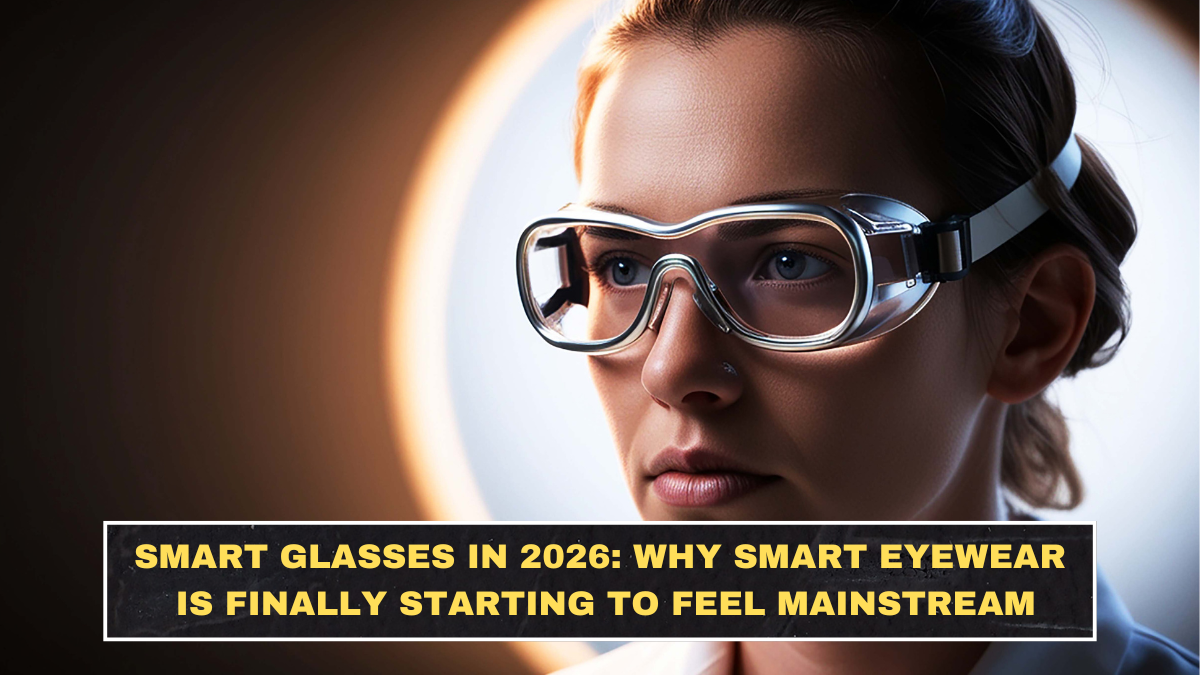
Smart glasses are getting more attention because the category finally has real momentum instead of just demos and promises. Grand View Research estimates the global smart glasses market was worth about $2.46 billion in 2025 and projects it could reach $14.38 billion by 2033, showing that the business side is now large enough to matter. That does not prove every product is good, but it does prove the category is no longer a dead-end curiosity.
The bigger signal is actual unit sales. EssilorLuxottica reported that Meta-linked AI glasses units sold were above 7 million in the full year, and Reuters also reported that U.S. smart glasses sales tripled year over year in 2025. That is the kind of shift that turns a niche gadget into a category people start taking seriously.
What changed this time compared with older smart glasses failures?
Older smart glasses usually failed because they were too awkward, too early, or too unclear about what problem they solved. This time, the products are leaning on simpler use cases first: hands-free photos, audio, voice AI, translation, and lightweight everyday assistance. That is a much smarter entry point than trying to force consumers into full augmented reality before the hardware is ready. Google’s Android XR demos focused on messaging, directions, appointments, photos, and live language translation, which is a much more practical pitch than the old “future computer on your face” fantasy.
Style also matters more now. Google said it is working with eyewear brands including Gentle Monster and Warby Parker because glasses only become useful if people actually want to wear them all day. That sounds obvious, but the industry ignored it for years. Smart eyewear is finally feeling more mainstream because companies are treating it like eyewear first and hardware second.
What can smart glasses actually do well in 2026?
The strongest use cases are still hands-free ones. Meta’s official materials for its newer AI glasses highlight live captions, translation, text translation, and voice-driven assistance, while earlier Meta updates added real-time speech translation, visual questions, and memory-style features such as helping you remember where you parked. Google’s Android XR demos similarly emphasized messaging, navigation, translation, and phone-connected assistance.
That matters because these are tasks where the glasses format actually helps. If you are walking, traveling, commuting, or doing something with your hands busy, glasses can be more natural than pulling out a phone. The category starts making sense when it reduces friction in short, repeated daily actions. It still looks weaker when brands try to pretend smart glasses are ready to replace phones entirely.
Are smart glasses actually mainstream now?
Not fully, and this is where people need to stop lying to themselves. The category has momentum, but Reuters said in late 2025 that smart glasses were still a specialty gadget despite fast sales growth, with privacy, comfort, and price still slowing wider adoption. That means the trend is real, but the mainstream claim is still only partially true.
A better way to say it is this: smart glasses are becoming more normal, not yet universal. They have moved past the “dead gadget” phase, but they have not yet reached smartphone-level necessity. What changed is that enough people now see a reason to buy them, especially for AI help, audio, translation, and camera-based convenience.
Which companies are pushing the category forward most aggressively?
Meta is clearly leading the consumer side right now, mostly because it already has scale in the market through Ray-Ban Meta and related glasses sold with EssilorLuxottica. The reported 7 million-plus units sold gives Meta a serious head start in real consumer adoption.
Google is the other major force because Android XR is being positioned as a platform for glasses and headsets, not just a single device. Reuters reported that Warby Parker and Google are developing AI-powered smart glasses for a 2026 launch, while Google has also said Android XR glasses will bring Gemini-powered assistance into real-world use cases. Snap is still very much in the race too, with Reuters reporting that its Specs smart glasses are launching later in 2026 using Qualcomm chips.
What do buyers actually expect from the next wave?
| Expectation | Why it matters in 2026 |
|---|---|
| Better-looking frames | People will not wear ugly hardware all day |
| Better AI assistance | Voice and context are now the core value |
| Translation and captions | Clear everyday use case for travel and conversation |
| Longer battery life | Glasses fail fast if they feel fragile or annoying |
| Lighter weight and more comfort | Wearability matters more than raw specs |
This is the real table buyers should use. Most people do not care about futuristic language. They care whether the glasses look normal, feel comfortable, last long enough, and do something useful more than once a week. That is why Meta, Google, Warby Parker, Gentle Monster, and Snap all keep talking about wearability, AI, and real-life utility rather than only raw AR spectacle.
What is still holding smart glasses back?
Price is still a problem. Reuters noted that Meta’s more advanced smart glasses were priced around $799 while simpler models sat in the $300 to $400 range, which is still expensive for a category many people view as optional. Comfort, battery life, privacy, and social acceptability also remain real barriers. If people feel watched, awkward, or overcharged, the category stalls.
The other problem is expectation inflation. Too many buyers still expect these products to behave like perfect AI companions or phone replacements. They are not there yet. Right now, smart glasses work best as quick-access wearable assistants, not as your only screen or your only computing device. That distinction matters, because hype ruins categories faster than bad hardware does.
Conclusion
Smart glasses are finally starting to feel mainstream in 2026 because the category now has three things it lacked before: real sales momentum, better-looking hardware, and clearer use cases. Meta has proven there is real consumer demand, Google is building an ecosystem around Android XR, and Snap is still pushing toward broader consumer launch. The market data and company moves both show this is no longer a dead-end experiment.
But let’s not get carried away. Smart glasses are becoming more credible, not fully essential. They are strongest when they help with translation, captions, audio, navigation, and fast AI assistance. They are weakest when people pretend they have already replaced the smartphone. The category is real now. The revolution part is still ahead of itself.
FAQs
Are smart glasses really popular in 2026?
They are much more popular than before, but they are not fully mainstream yet. Sales have risen sharply, and Meta-linked glasses alone sold above 7 million units in the full year, but Reuters still described smart glasses as a specialty gadget in late 2025.
What are the most useful smart glasses features right now?
The most useful features are live translation, captions, voice AI help, hands-free photos, messaging, and navigation support. Those are the use cases official Meta and Google materials keep emphasizing.
Which companies matter most in smart glasses right now?
Meta is the biggest current consumer force, while Google is building Android XR as a platform for future glasses. Snap is also still competing with consumer Specs planned for 2026.
What is the biggest reason smart glasses still are not everywhere?
The biggest reasons are still price, comfort, privacy concerns, and the fact that many buyers do not yet see them as essential. The category has grown, but it has not fully crossed into must-have status.