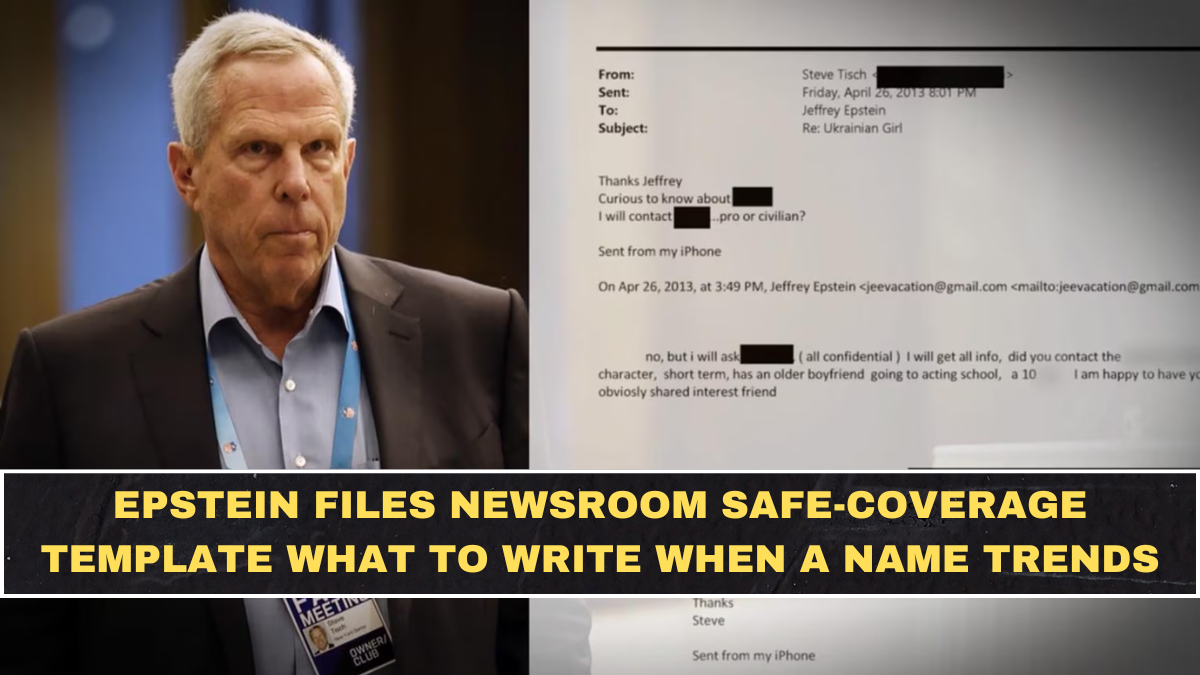
When a name suddenly trends alongside the Epstein files, speed becomes the enemy of accuracy. Social platforms reward instant takes, but legal reality moves slower and demands precision. In 2026, the risk is not just getting a detail wrong; it is permanently associating a person with wrongdoing based on fragments, screenshots, or context-free mentions. That harm cannot be undone once it spreads.
This article provides a practical, newsroom-safe template for covering these spikes responsibly. It tells you what to write first, what to avoid entirely, and how to verify claims quickly without turning uncertainty into accusation. The goal is not to minimize the story, but to report it in a way that protects readers, victims, and innocent third parties while preserving credibility.
Start With What Is Confirmed, Not What Is Trending
The first paragraph should state only what is verifiably confirmed at that moment. This usually includes the fact that certain documents exist, that a review or access change occurred, or that a name is appearing in online discussion. Avoid leading with conclusions or implications.
By grounding the opening in confirmed process rather than viral interpretation, you set expectations correctly. Readers understand that the update is about information flow, not a verdict. This framing reduces panic sharing and keeps the story anchored to facts.
Explain Why a Name Might Appear in Records
Names appear in records for many non-criminal reasons, and this context must be explained early. A name can be mentioned in testimony, correspondence logs, scheduling notes, or third-party statements without any allegation attached. Treating appearance as implication is the most common and damaging error.
This explanation is not a defense of anyone; it is a clarification of how records work. When readers understand that documents capture references rather than judgments, they are less likely to jump to conclusions.
Separate Documents From Claims About Documents
One of the safest structural choices is to clearly separate what a document contains from what people are claiming it means. Use neutral language to describe the material, then attribute interpretations explicitly to online posts or commentators without endorsing them.
This separation prevents your coverage from becoming the vehicle for an unverified narrative. It also protects you legally by making clear that claims are being reported as claims, not established facts.
What to Avoid Saying Under Any Circumstances
Never imply guilt, involvement, or wrongdoing based solely on a name appearing in records. Avoid phrases that suggest confirmation, exposure, or revelation unless there is a formal finding or charge. Words like “implicated,” “exposed,” or “linked” should be used only when legally accurate and supported.
Also avoid publishing cropped screenshots or partial pages that remove context. These visuals often mislead more than they inform and can make your coverage indistinguishable from rumor amplification.
The Fast Verification Checklist Editors Can Run
Verification under time pressure is possible if you focus on structure rather than volume. Check whether the claim points to a specific document, filing, or procedural update. Look for consistency in dates, formatting, and language that matches known records.
If a claim relies entirely on screenshots or unnamed sources, flag it as unverified. The absence of clear provenance is itself a fact worth stating, and it protects your audience from assuming certainty where none exists.
How to Phrase Uncertainty Without Sounding Weak
Uncertainty does not undermine authority if it is explained clearly. Phrases like “there is no confirmation,” “the documents do not establish,” or “the claim has not been independently verified” are informative, not evasive. They tell readers exactly where the information boundary lies.
In sensitive stories, restraint builds trust. Readers return to outlets that help them understand limits rather than pretending to have answers that do not exist.
Handling Updates as the Story Evolves
When updates occur, add them as clearly labeled sections rather than rewriting the entire piece to chase virality. This preserves the historical record of what was known when and prevents confusion caused by retroactive edits.
A timeline approach also helps readers see patterns, such as repeated spikes driven by the same material. Over time, this reduces the impact of recycled misinformation.
Why This Template Protects Both Readers and Publishers
Responsible framing does more than avoid lawsuits. It protects victims from renewed exposure, shields innocent individuals from reputational harm, and maintains the publisher’s credibility. In 2026, trust is a competitive advantage, especially in high-noise topics.
Using a consistent template also helps internal teams move faster without cutting corners. Speed comes from clarity, not from skipping safeguards.
Conclusion: Accuracy Is the Headline That Lasts
When a name trends in connection with the Epstein files, the pressure to publish is intense. The safest and strongest response is not silence or sensationalism, but structure. By leading with confirmation, explaining context, and clearly marking uncertainty, you inform without inflaming.
This template turns a chaotic moment into a controlled report. It keeps the focus on what is known, what is not, and why that distinction matters. In a story this sensitive, accuracy is not just ethics—it is the story.
FAQs
Why shouldn’t names be treated as proof of wrongdoing?
Because records often include references without allegations, and appearance alone does not establish guilt or involvement.
Is it safe to publish viral screenshots of documents?
No. Screenshots often remove context and can be edited, making them unreliable for responsible reporting.
How fast can verification realistically happen?
Basic structural verification can be done in minutes by checking provenance, consistency, and sourcing.
What if competitors publish stronger claims first?
Publishing unverified claims may gain clicks but damages trust. Accurate coverage sustains credibility long-term.
Should articles be updated or rewritten when new info appears?
Updates should be added clearly to preserve context and prevent reader confusion.
Who benefits from this cautious approach?
Readers, victims, innocent third parties, and publishers all benefit from accurate, restrained reporting.