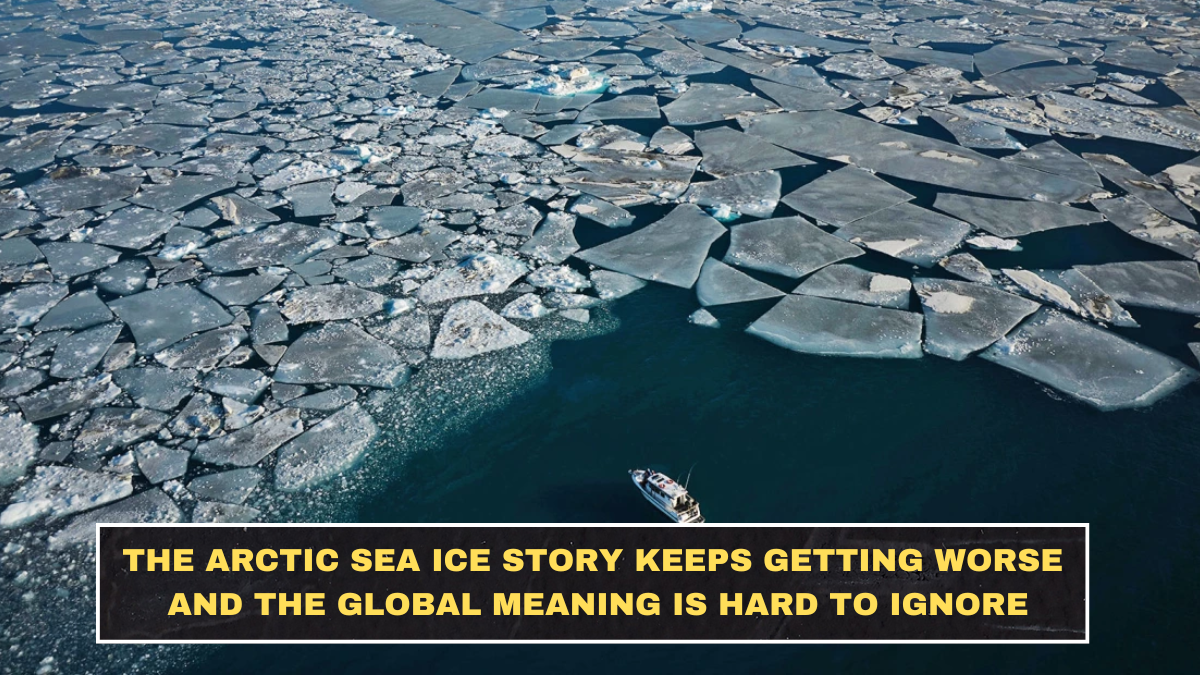
Arctic sea ice hit another winter low in March 2026, and that matters because the winter maximum is supposed to be the season when the ice is at its strongest. The National Snow and Ice Data Center said Arctic sea ice likely reached its yearly peak on March 15, 2026, at 14.29 million square kilometers, statistically tied with 2025 for the lowest winter maximum in the 48-year satellite record. That is not just a bad headline. It means the Arctic entered the melt season from a weaker starting point again.
What the new record actually means
A lot of climate coverage gets sloppy here. The winter maximum is not the same thing as the summer minimum. The maximum is the point in March when Arctic sea ice is usually at its largest annual extent. When that peak is at or near record lows, it suggests the Arctic built less protective ice through the cold season than it used to. NOAA’s 2025 Arctic Report Card already said March 2025 set the prior record-low winter maximum, and 2026 has now matched or slightly undercut it.
Why scientists care so much about the winter peak
The winter peak matters because it sets the baseline for the warmer months. Less ice in March usually means less reflective white surface heading into spring and summer, which allows the ocean to absorb more heat. NOAA explains that sea ice helps reflect sunlight back into space instead of letting darker ocean water absorb it. Once that protective cover shrinks, warming can reinforce itself. That is why record-low winter ice is not just a seasonal curiosity. It changes the system the summer melt starts from.
The bigger climate signal is hard to deny
This is not a one-year freak event. NSIDC said the 2026 peak ties the record low from 2025, and NOAA’s Arctic Report Card showed that the last 20 years have been marked by lower sea-ice extent and younger, thinner ice cover. Reuters also noted in its recent climate overview that the Arctic experienced a record-low winter maximum during 2025. In plain language, the long-term pattern is still down, and the ice is not bouncing back in any meaningful way.
The key numbers at a glance
| Measure | Latest figure | Why it matters |
|---|---|---|
| 2026 winter maximum extent | 14.29 million sq km | Tied for lowest in satellite record |
| Date of likely 2026 peak | March 15, 2026 | Shows the melt season starts from a weak base |
| Previous record-low maximum | 14.31 million sq km in 2025 | Confirms this is back-to-back extreme weakness |
| Length of satellite record | 48 years | Gives context for how unusual this is |
This table is the useful part, not the dramatic adjectives. The Arctic is posting repeated extreme lows at the point in the year when it should be most resilient.
Why this matters beyond the Arctic
People make the mistake of treating Arctic sea ice as a remote problem. It is not. Arctic sea ice influences how much solar energy the planet absorbs, affects ocean-atmosphere interactions, and is part of the wider climate system that shapes weather and heat patterns. NOAA’s Arctic reporting has repeatedly linked declining sea ice to broader warming and ecosystem stress. So no, this is not just about polar bears and distant ice maps. It is about a fast-changing part of the Earth system that helps regulate the whole climate.
What to watch next
The next important signals are straightforward:
- how fast the 2026 melt season accelerates from this weak March base
- whether summer 2026 sea ice also ranks near record lows
- whether Arctic Ocean temperatures stay unusually elevated
A weak winter maximum does not guarantee a record summer minimum, but it clearly raises concern going into the warmer months. That last point is an inference supported by NOAA and NSIDC’s explanation of how sea ice cycles and thinning work.
Conclusion
The Arctic sea ice story keeps getting worse because the region is now repeating extreme lows even at winter’s peak. March 2026 did not produce a meaningful recovery. It produced another tied record low. That means the Arctic is entering another melt season already weakened, and the broader climate signal is becoming harder to dismiss without fooling yourself.
FAQs
What happened to Arctic sea ice in March 2026?
NSIDC said Arctic sea ice likely reached its annual maximum on March 15, 2026, at 14.29 million square kilometers, tied for the lowest winter peak in the 48-year satellite record.
Why is the winter maximum important?
Because it shows how much ice the Arctic built during the cold season and sets the starting point for the summer melt.
Does one low winter peak prove climate change?
One year alone would not, but repeated record or near-record lows over decades strongly fit the long-term warming trend documented by NOAA and NSIDC.
Does low Arctic sea ice affect the rest of the world?
Yes. Sea ice affects how much sunlight is reflected back into space and is part of the broader climate system, so changes in the Arctic do not stay isolated there.