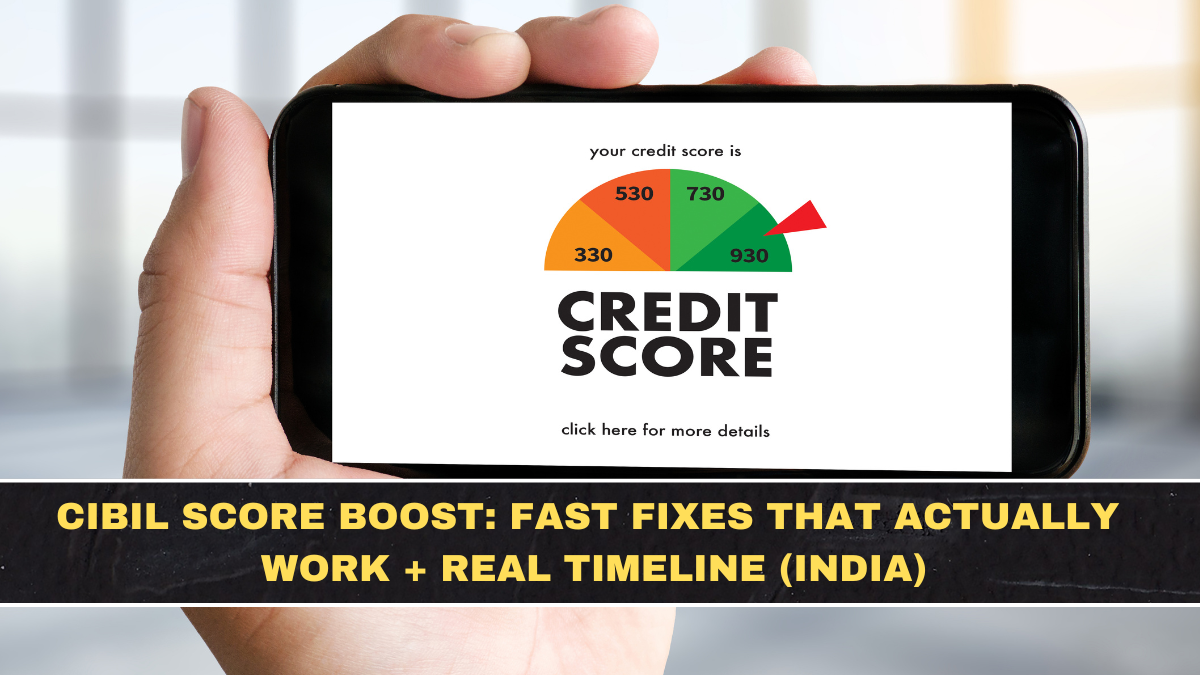
In India, CIBIL scores range from 300 to 900, and most banks prefer a score of 750+ for smooth loan approvals. According to lending industry data, borrowers above 750 often receive lower interest rates compared to those below 700. Even a 50–70 point difference can impact approval probability and loan pricing.
A low score increases rejection risk for home loans, personal loans, and premium credit cards. Understanding how to improve it with measurable actions is critical if you plan to borrow within the next 6–12 months.
What Actually Impacts Your CIBIL Score (With Weightage)
Credit bureaus calculate your score based on defined parameters. While the exact algorithm is proprietary, industry-level weightage estimates are widely accepted.
| Factor | Approximate Impact Weight | Why It Matters |
|---|---|---|
| Payment History | ~35% | Late payments heavily reduce score |
| Credit Utilization | ~30% | High usage signals risk |
| Credit Age | ~15% | Longer history improves trust |
| Credit Mix | ~10% | Balanced secured + unsecured profile |
| Recent Inquiries | ~10% | Too many loan applications reduce score |
Payment behavior and utilization together account for nearly two-thirds of the score impact. That means most improvement strategies should focus there.
Fastest Ways to Improve CIBIL Score (Data-Based Impact)
If you need improvement quickly, focus on high-impact levers.
Reducing credit utilization from 75% to below 30% can improve score by 20–50 points within one reporting cycle. Clearing overdue payments can prevent further damage and gradually recover lost points over 2–3 months.
Correcting reporting errors such as duplicate loans or incorrect “written-off” status can lead to improvement of 50–100 points, depending on severity.
The key is to prioritize actions with measurable influence rather than trying random tactics.
Credit Score Improvement Timeline (Realistic Expectations)
Score recovery is not instant. Here’s a practical timeline based on common scenarios.
| Situation | Possible Score Impact | Typical Timeline |
|---|---|---|
| Correcting report errors | 30–100 point jump | 30–45 days |
| Reducing utilization below 30% | 20–50 point increase | 30–60 days |
| Consistent on-time payments | Gradual 10–20 points | 3–6 months |
| Recovering from missed EMI | Slow rebuilding | 6–12 months |
| Loan settlement marked “closed” | Moderate recovery | 6–9 months |
Major defaults take longer to repair. Minor utilization issues recover faster.
Utilization Ratio: The Quickest Lever You Control
Credit utilization ratio is calculated as:
(Total Outstanding Credit ÷ Total Credit Limit) × 100
For example, if your total credit limit is ₹2,00,000 and you are using ₹1,40,000, your utilization is 70%, which is considered high risk. Reducing this to ₹60,000 outstanding lowers utilization to 30%, significantly improving score perception.
Requesting a credit limit increase without increasing spending can also reduce utilization ratio mathematically.
How Payment History Affects Your Score
Even a single 30-day delay can drop your score by 50–100 points, depending on your prior profile strength. Multiple missed EMIs cause cumulative damage.
Enabling AutoPay for EMIs and credit card bills eliminates this risk. Payment consistency over 6–12 months rebuilds trust gradually.
Errors That Artificially Lower Your Score
Common reporting mistakes include:
-
Closed loans shown as active
-
Settled loans marked incorrectly
-
Duplicate credit accounts
-
Incorrect overdue status
-
Wrong personal identification details
Raising disputes through the credit bureau usually takes 30–45 days for resolution. Always review your credit report at least once a year.
What Does NOT Improve Your Score
Many myths circulate about boosting CIBIL scores.
-
Taking a new loan just to build score
-
Closing old credit cards unnecessarily
-
Frequently checking your own score
-
Using full credit limit and repaying before due date
These actions either have minimal impact or can negatively affect your score.
Target Score and Loan Eligibility Benchmarks
| CIBIL Score Range | Loan Approval Probability | Interest Rate Advantage |
|---|---|---|
| 800–900 | Very High | Lowest available rates |
| 750–799 | High | Competitive rates |
| 700–749 | Moderate | Slightly higher rates |
| 650–699 | Low | High risk pricing |
| Below 650 | Very Low | Likely rejection |
Improving from 690 to 750 can significantly increase loan approval odds.
Conclusion
CIBIL score improvement is not about shortcuts; it is about measurable corrections and disciplined financial behavior. Payment history and utilization ratio together determine most of your score outcome. Reducing utilization below 30%, correcting errors, and maintaining consistent on-time payments can deliver visible improvement within 1–3 months.
Long-term credit health requires stability, not aggressive credit usage. If you plan to apply for a major loan, start improving your score at least 6 months in advance.
FAQs
How fast can my CIBIL score increase?
Minor improvements like utilization correction may reflect within 30–60 days, while recovery from defaults may take 6–12 months.
What is the ideal credit utilization ratio?
Keeping utilization below 30% of total credit limit is widely recommended for maintaining a healthy score.
Does checking my CIBIL score reduce it?
No, self-checks are soft inquiries and do not affect your score.
Can I improve my score by taking a small loan?
Not necessarily. Taking loans without need may increase inquiry count and risk profile.