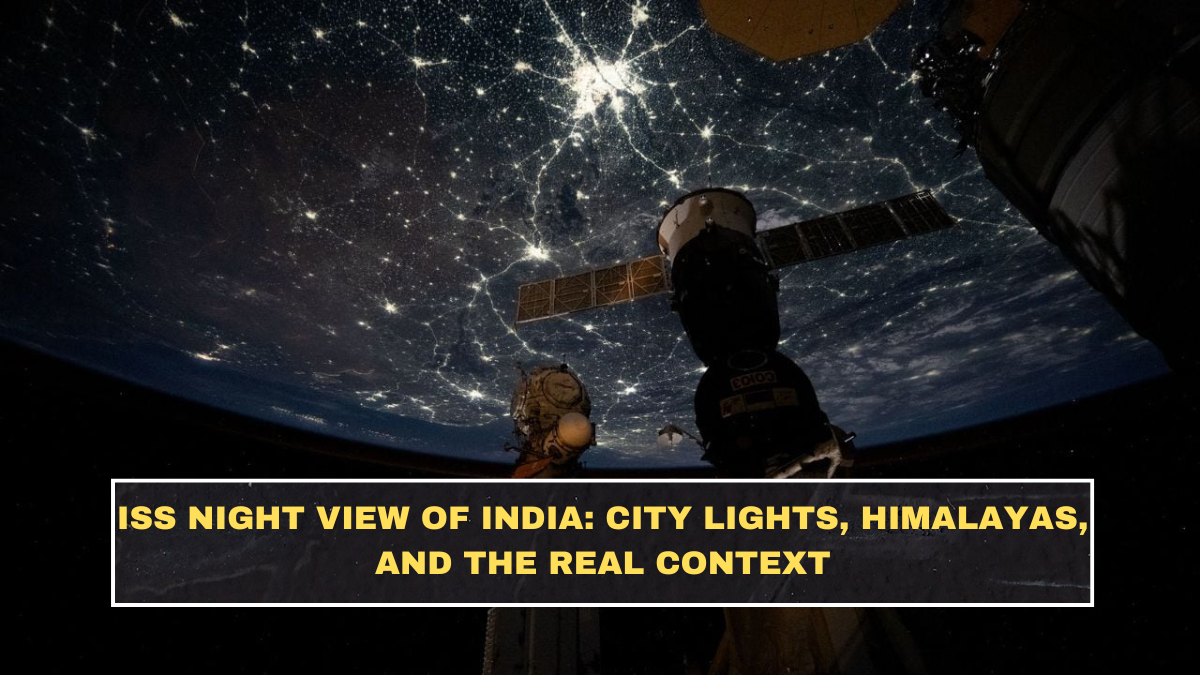
Images showing the night view of India from the International Space Station (ISS) often circulate widely on social media because they reveal how human settlements appear from orbit. These photographs highlight dense clusters of city lights, transportation corridors, and dark natural landscapes such as oceans and mountain ranges.
Many viewers are particularly curious about why some parts of India appear extremely bright while others remain almost completely dark. Understanding the geographical and urban patterns visible from space helps explain the context of these viral images.
Basic Facts About the International Space Station
The International Space Station is a research laboratory orbiting Earth where astronauts conduct scientific experiments and capture photographs of the planet. Because the station travels around Earth roughly every 90 minutes, astronauts frequently see different regions during each orbit.
Below is a quick snapshot of the ISS.
| Feature | Details |
|---|---|
| Name | International Space Station |
| Orbit Altitude | ~400 km above Earth |
| Orbit Speed | ~28,000 km/h |
| Orbit Duration | Around 90 minutes |
| Partner Agencies | NASA, Roscosmos, ESA, JAXA, CSA |
These orbital characteristics allow astronauts to photograph the same region multiple times under different lighting conditions.
Why India’s City Lights Are Visible from Space
Nighttime photographs taken from space mainly capture artificial light sources. Cities produce large amounts of light from streets, homes, commercial buildings, and transportation systems.
The density of lights typically corresponds to population distribution.
| Light Pattern | Meaning |
|---|---|
| Bright clusters | Large cities and metropolitan areas |
| Long light lines | Major highways or transportation routes |
| Dim scattered lights | Smaller towns or rural areas |
| Dark regions | Forests, mountains, or oceans |
This is why regions with high population density appear much brighter in satellite or space-station images.
Why the Himalayas Appear Dark
One striking feature in nighttime space images of India is the dark region corresponding to the Himalayan mountain range. Unlike urban regions, mountainous terrain contains far fewer cities and artificial light sources.
The contrast between the illuminated plains and the dark mountains makes the Himalayas clearly visible in night photographs.
| Region | Appearance at Night |
|---|---|
| Indo-Gangetic Plain | Dense light clusters |
| Western India | Urban corridor lights |
| Himalayan Range | Mostly dark terrain |
| Indian Ocean | Completely dark water |
This contrast creates the recognizable outline of northern India when viewed from space.
Major Cities Visible in Night Images
Certain cities appear extremely bright in nighttime photographs because of their large populations and extensive infrastructure.
Examples of major light clusters visible from space include:
| City | Region |
|---|---|
| Delhi | Northern India |
| Mumbai | Western India |
| Kolkata | Eastern India |
| Bengaluru | Southern India |
| Chennai | Southeastern coast |
These metropolitan areas produce high concentrations of light that are easily visible from orbit.
How Nighttime Earth Images Are Captured
Astronauts on the ISS use professional cameras with long exposure settings to capture nighttime images of Earth. Long exposure allows the camera to gather more light, making city lights clearly visible despite the darkness of space.
The process usually includes the following steps.
| Step | Purpose |
|---|---|
| Camera positioning | Align camera with Earth’s surface |
| Long exposure | Capture faint city lights |
| Stabilization | Reduce motion blur from ISS movement |
| Image processing | Enhance contrast and clarity |
These techniques allow astronauts to produce clear photographs even while the station travels at very high speed.
Why Such Images Spread Quickly Online
Space images frequently become viral online because they offer a unique perspective of familiar locations. Seeing one’s country illuminated from space creates a strong visual impact that encourages sharing.
Several factors contribute to the viral spread of these images.
| Factor | Impact |
|---|---|
| Visual uniqueness | Rare perspective of Earth |
| Social media sharing | Rapid global distribution |
| Scientific curiosity | Interest in space exploration |
| Geographic recognition | Viewers identifying cities |
These elements help transform space photographs into widely shared content.
Scientific Uses of Nighttime Earth Images
Nighttime images of Earth are not only visually impressive but also scientifically valuable. Researchers analyze light patterns to study urban development and environmental changes.
Examples of research applications include:
| Research Field | Application |
|---|---|
| Urban growth studies | Tracking expansion of cities |
| Energy analysis | Monitoring electricity use |
| Disaster response | Identifying power outages |
| Environmental science | Measuring human activity impact |
These data sources help scientists understand how human civilization evolves over time.
Conclusion
The ISS night view of India highlights the remarkable contrast between densely populated cities and natural landscapes such as mountains and oceans. Bright clusters of lights represent major urban areas, while darker regions often correspond to rural terrain or geographic features like the Himalayas.
Beyond their visual appeal, these images also provide valuable insights for researchers studying urbanization and environmental patterns. As astronauts continue photographing Earth from orbit, viewers will gain even more fascinating perspectives of the planet.
FAQs
Why are Indian cities so bright in space photos?
Large cities produce significant artificial lighting from infrastructure, making them highly visible in nighttime images taken from orbit.
Why do the Himalayas appear dark in space images?
The Himalayan region has fewer urban settlements and less artificial lighting, making it appear darker than surrounding areas.
How are nighttime images taken from the ISS?
Astronauts use high-resolution cameras with long exposure settings to capture city lights from orbit.
What is the altitude of the International Space Station?
The ISS typically orbits Earth at approximately 400 kilometers above the planet’s surface.