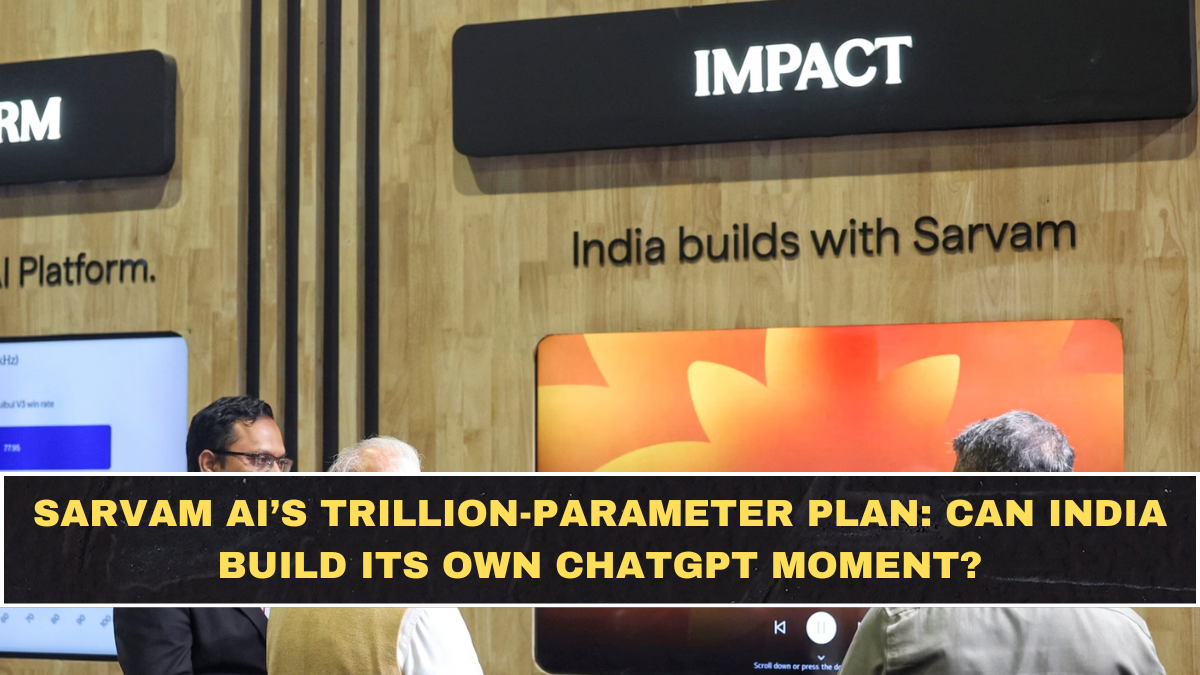
Sarvam AI has put India’s artificial intelligence ambitions back in the spotlight after co-founder Pratyush Kumar said the company plans to train its first trillion-parameter AI model within the next nine months. Speaking at the CII Business Summit 2026, Kumar argued that India cannot remain only a passive consumer of global AI systems if it wants to shape the future of technology.
This is not just another startup announcement. A trillion-parameter model would place Sarvam’s ambition in the same conversation as frontier-scale AI systems built by global giants. But ambition alone does not build AI dominance. India will need compute, research talent, high-quality data, serious capital and long-term policy clarity if this plan is to become more than a headline.

What Is Sarvam Planning?
| Key Point | Current Update | Why It Matters |
|---|---|---|
| Company | Sarvam AI | Indian sovereign AI startup |
| Founder voice | Pratyush Kumar | Pushing homegrown frontier models |
| Target model | Trillion-parameter AI model | Major scale jump for India |
| Timeline | Within next nine months | Aggressive development window |
| Earlier models | 30B and 105B models | Shows existing model-building base |
| Bigger theme | Sovereign AI | India wants control over core AI capability |
Sarvam has already released 30-billion and 105-billion parameter models designed for Indian language use cases. Fortune India reported that the 30B model is built as an efficient workhorse for large-scale conversations, while the 105B model targets complex reasoning with a larger context window. That gives Sarvam a foundation, but a trillion-parameter model would be a much larger jump in complexity.
Why Does A Trillion-Parameter Model Matter?
A parameter is one of the internal values a model learns during training, and larger models can sometimes handle more complex language, reasoning and pattern recognition. But bigger is not automatically better. A massive model can still fail if the data is weak, the training is inefficient or the product does not solve real user problems.
For India, the trillion-parameter goal matters because it signals strategic seriousness. Global AI power is increasingly controlled by companies and countries that own foundational models. If India only uses foreign models, it may save money today but lose long-term control over data, standards, pricing and technology direction.
Why Is Sarvam Talking About Sovereign AI?
Sarvam describes itself as India’s full-stack sovereign AI platform, building models and applications for Indian languages, culture and enterprise use cases. Its website highlights sovereign deployment, Indian-language capability, voice agents, speech tools, translation, dubbing and vision systems.
That positioning is important because India is not a single-language AI market. Real adoption requires Hindi, Tamil, Bengali, Marathi, Punjabi, Telugu, Kannada, Malayalam and many other languages, including code-mixed speech. A model built mainly for English-speaking users will not fully serve India’s billion-scale population.
What Makes This Hard?
The hard part is not announcing the model; the hard part is training and running it properly. Frontier AI needs huge compute clusters, clean datasets, strong safety work, evaluation systems and engineers who understand large-scale distributed training. Without that stack, a trillion-parameter claim can become expensive noise.
Sarvam’s challenge is clear:
- Build large models without burning unsustainable money.
- Train on high-quality Indian language and multimodal data.
- Compete with OpenAI, Google, Anthropic and Meta-level ecosystems.
- Make AI useful for government, enterprises and ordinary users.
- Keep costs low enough for Indian-scale adoption.
- Avoid building a model that looks impressive but lacks daily utility.
Can India Compete With Global AI Leaders?
India can compete, but not by copying Silicon Valley blindly. The sharper opportunity is Indian-language AI, voice-first interfaces, public-service automation, enterprise workflows and affordable deployment at massive scale. Sarvam’s earlier models were built for all 22 official Indian languages and voice-first usage, which is a smarter local wedge than trying to beat every global model on every benchmark.
The uncomfortable truth is that India is late in frontier AI infrastructure compared to the US and China. But India has population scale, language complexity, engineering talent and government interest. If those are combined properly, India does not need to win every global leaderboard to build powerful domestic AI capability.
What Should India Watch Now?
The next nine months will decide whether Sarvam’s plan becomes a serious national milestone or just another inflated AI promise. Investors, policymakers and developers should watch for training progress, compute partnerships, model openness, benchmark results, safety evaluations and real product deployments.
The biggest signal will be usefulness. If the model can help Indian businesses, government services, developers, farmers, students and call-centre workflows in Indian languages, it will matter. If it only becomes a prestige model with limited access and high cost, the “India’s ChatGPT moment” headline will fade quickly.
Conclusion: Is This India’s ChatGPT Moment?
Sarvam AI’s trillion-parameter plan is a bold signal that India wants to own part of the AI future instead of renting intelligence from foreign platforms forever. The ambition is necessary because AI will influence governance, business, science, education and manufacturing. Countries that own foundational technology will shape the rules; countries that only consume it will follow them.
But the hard truth is simple: slogans will not build sovereign AI. Sarvam must prove scale, quality, cost efficiency and real-world usefulness. If it does, India may finally get its strongest homegrown AI moment. If it does not, this will become another big announcement swallowed by global competition.
FAQs?
What Is Sarvam AI Planning To Build?
Sarvam AI plans to train its first trillion-parameter AI model within the next nine months. The plan was discussed by co-founder Pratyush Kumar at the CII Business Summit 2026 as part of India’s push for homegrown AI capability.
Why Is A Trillion-Parameter Model Important?
A trillion-parameter model signals frontier-scale AI ambition. It could help India build stronger domestic capability, but size alone is not enough; data quality, training efficiency, safety and real-world usefulness matter just as much.
Has Sarvam Built AI Models Before?
Yes, Sarvam has already released 30B and 105B models designed for India-focused deployment. These models are built for Indian languages, voice-first use cases and enterprise-scale applications.
Can Sarvam Compete With OpenAI And Google?
Sarvam can compete in India-specific AI use cases, especially Indian languages, voice agents, public services and enterprise workflows. Competing directly with OpenAI or Google globally will require massive compute, capital, research talent and consistent model performance.