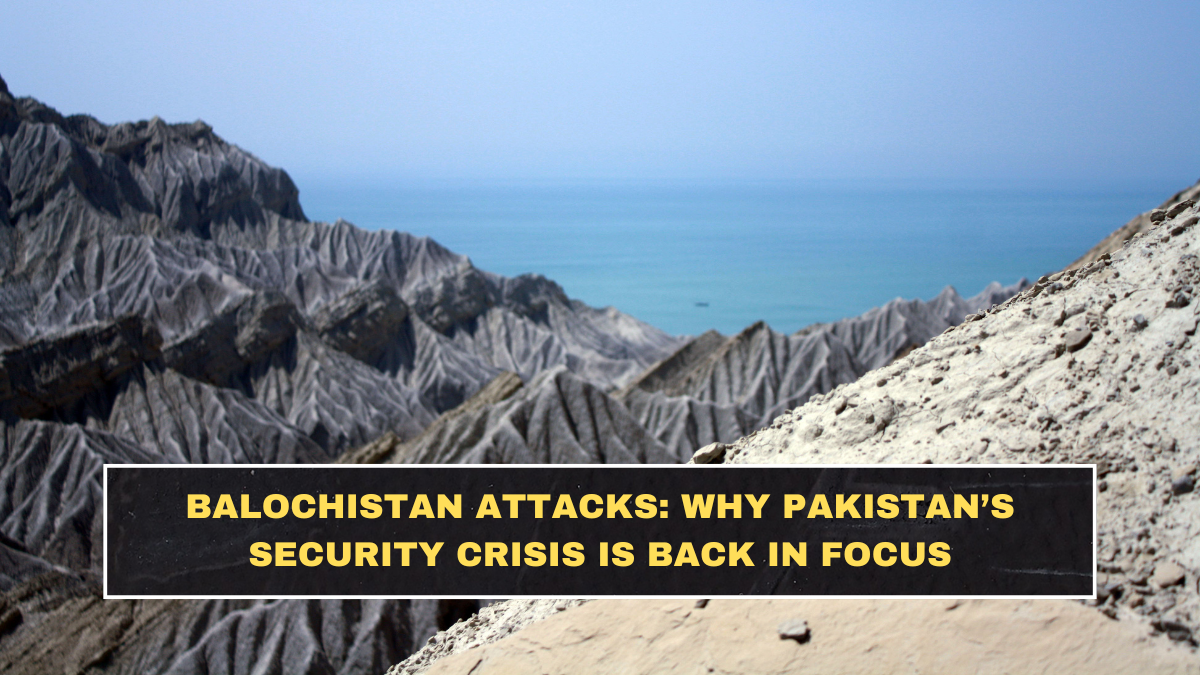
Balochistan attacks are back in the news because the banned Baloch Liberation Army has claimed a fresh wave of operations across Pakistan’s largest province. According to Times of India, the BLA claimed 27 attacks between April 15 and April 25, 2026, and said 42 Pakistani soldiers were killed. These are militant claims, so they should be treated carefully unless independently verified. (timesofindia.indiatimes.com)
The reason this matters is simple: Balochistan has already seen a sharp rise in militant activity this year. Earlier in 2026, Pakistan faced one of its deadliest waves of coordinated attacks in the province, with assaults reported in multiple districts including Quetta, Gwadar, Mastung, Nushki, and Pasni. Reuters reported that those attacks targeted hospitals, schools, banks, markets, and security installations.
This is not just a law-and-order issue. Balochistan is strategically important because of its minerals, ports, highways, energy routes, and location near Iran and Afghanistan. When violence rises there, it affects Pakistan’s internal stability, foreign investment, Chinese-linked projects, regional security, and civilian life.
Who Is The Baloch Liberation Army?
The Baloch Liberation Army is a banned separatist militant group that says it is fighting for Baloch rights and independence. Pakistan, the United States, and several other governments have designated or treated it as a terrorist organisation because of its attacks on security forces, civilians, infrastructure, and foreign-linked projects.
The BLA has been active for years, but its tactics have become more visible and more violent in recent years. Reuters reported that the group claimed the large February 2026 wave of attacks under an operation it called “Herof,” meaning “black storm,” targeting both government and civilian areas.
The group frames itself as a nationalist resistance movement, but attacks on civilians, public buildings, schools, markets, and non-combatant workers undermine that claim. No political grievance gives any group a free pass to target ordinary people. That is the part sympathisers often avoid saying clearly.
What Happened In The Earlier 2026 Attacks?
In late January and early February 2026, Balochistan saw coordinated gun and bomb attacks across several districts. Reuters reported that Pakistani security forces later said they had killed 145 militants in a 40-hour battle after attacks that killed 48 people, including 17 security personnel and 31 civilians.
The Associated Press reported similar details, saying the BLA claimed attacks that included suicide and gun assaults targeting government and civilian areas, while Pakistani officials accused militants of being backed by India and operating from Afghanistan. India denied the allegation and said Pakistan should address local grievances. (apnews.com)
| Issue | What Was Reported | Why It Matters |
|---|---|---|
| February 2026 attacks | Coordinated assaults across Balochistan | Shows planning and operational reach |
| Casualties | Civilians, security personnel, and militants killed | Human cost is high on all sides |
| Targets | Schools, hospitals, banks, markets, security sites | Civilian infrastructure became exposed |
| Pakistan response | Major counteroffensive and security operations | Indicates serious state pressure |
| Fresh BLA claims | 27 attacks claimed in 10 days | Suggests instability has not ended |
Why Is Balochistan So Hard To Stabilise?
Balochistan is hard to stabilise because the crisis is not only military. The province has long-running grievances around political representation, resource control, missing persons, economic neglect, and heavy security presence. Pakistan’s state response has often focused on force, but force alone rarely solves insurgencies rooted in identity and trust.
At the same time, militant violence has made the situation worse for ordinary Baloch people. Attacks disrupt schools, roads, hospitals, businesses, and daily movement. Civilians get trapped between state crackdowns and militant threats. That is the ugly reality of long insurgencies: the people in whose name violence is claimed often suffer the most.
Balochistan is also geographically difficult to secure. It is Pakistan’s largest province by area, with remote terrain, border links, scattered populations, and difficult policing conditions. Militants can exploit geography, local networks, and cross-border instability to keep pressure on the state.
Why Does This Matter Beyond Pakistan?
Balochistan matters beyond Pakistan because it is linked to regional security, China-Pakistan Economic Corridor projects, Gwadar port, mineral resources, and routes connecting South Asia, West Asia, and Central Asia. Violence there can make investors nervous and complicate Pakistan’s economic recovery efforts.
China has a direct interest because Chinese workers and projects have been targeted in past attacks. Reuters noted that the BLA has targeted security forces, Chinese workers, and infrastructure in earlier violence.
The situation also matters for India and Afghanistan because Pakistan often links Baloch militancy to external support. Those accusations fuel regional tensions. But blaming outsiders alone is not enough. Pakistan also has to confront domestic governance failures, because external actors can exploit grievances only when grievances already exist.
What Is Pakistan’s Security Challenge Now?
Pakistan’s security challenge is to stop militant attacks without deepening civilian alienation. That is easier said than done. Heavy operations may reduce militant capacity in the short term, but if civilians feel collectively punished, the state may lose more trust.
Security forces need intelligence-led operations, not blanket crackdowns. The government also needs political engagement, development credibility, human rights accountability, and transparent handling of missing-persons concerns. Without that, Balochistan will remain stuck in a cycle of attack, crackdown, anger, and fresh recruitment.
This is where Pakistan’s leadership faces a hard choice. It can keep treating Balochistan mainly as a security file, or it can treat it as a political and economic crisis with a security dimension. The first approach may control headlines temporarily. The second is harder, but more realistic if the goal is long-term stability.
Conclusion?
The latest BLA attack claims have brought Balochistan’s security crisis back into focus, but the problem is not new. The province has already seen deadly coordinated attacks in 2026, major counteroperations, civilian deaths, and fresh militant propaganda.
The uncomfortable truth is that Balochistan cannot be stabilised through slogans from any side. Militant attacks on civilians and infrastructure are indefensible. But Pakistan’s state also needs more than force; it needs political trust, accountability, development, and credible governance. Without that, the province will remain one of South Asia’s most dangerous fault lines.
FAQs
What Is Happening In Balochistan?
Balochistan has seen repeated militant attacks claimed by the Baloch Liberation Army, including a fresh claim of 27 attacks in April 2026. Earlier in the year, the province also saw coordinated gun and bomb attacks across multiple districts.
Who Is The Baloch Liberation Army?
The Baloch Liberation Army is a banned separatist militant group active in Pakistan’s Balochistan province. It says it is fighting for Baloch rights and independence, but it has been linked to attacks on security forces, civilians, infrastructure, and foreign-linked projects.
Why Is Balochistan Important For Pakistan?
Balochistan is important because it is rich in minerals, strategically located, and home to Gwadar port and major infrastructure routes. Instability there affects Pakistan’s security, economy, foreign investment, and regional relations.
Can Pakistan Solve The Balochistan Crisis Through Military Action Alone?
No, military action alone is unlikely to solve the crisis. Security operations may reduce immediate threats, but long-term stability also needs political dialogue, economic development, accountability, and serious attention to local grievances.