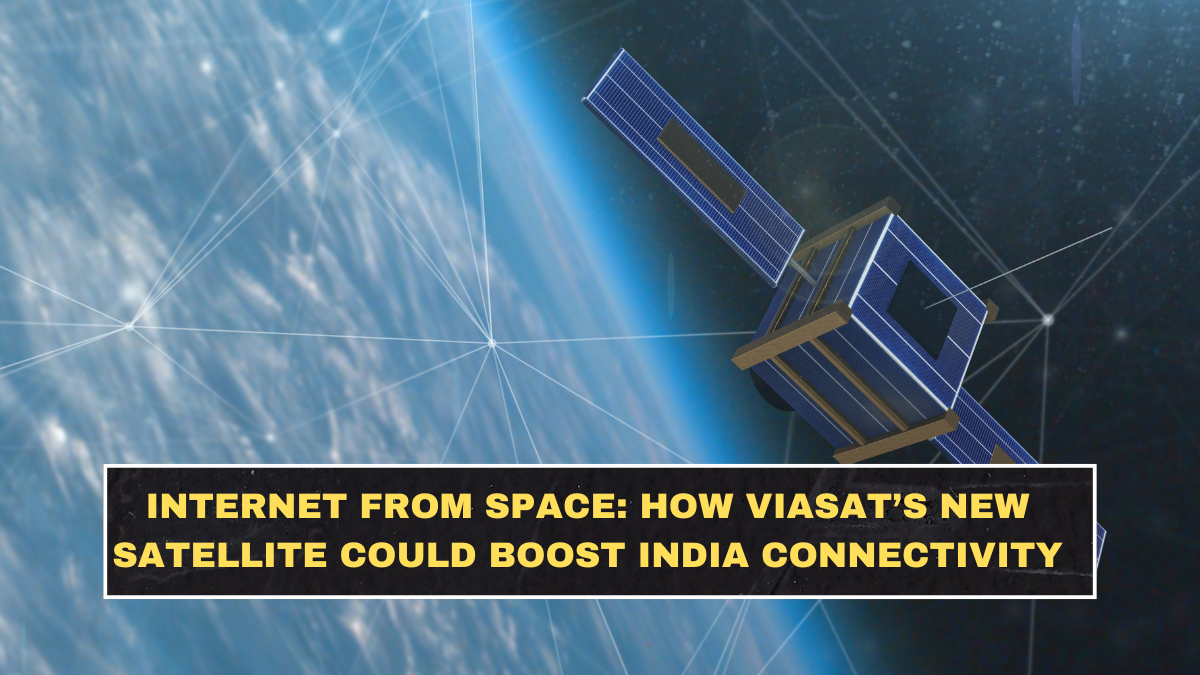
Viasat’s new satellite is in the news because the ViaSat-3 F3 satellite successfully launched from NASA’s Kennedy Space Center in Florida aboard a SpaceX Falcon Heavy rocket on April 29, 2026. The satellite is designed to serve the Asia-Pacific region, including India, and is expected to improve high-capacity broadband connectivity once it completes orbital testing and enters service.
India Today reported that ViaSat-3 F3 lifted off at 7:43 PM IST and separated from the rocket roughly five hours after launch. Viasat’s official update also confirmed that the satellite will travel for the next few months, deploy its systems, reach geostationary orbit, complete in-orbit testing, and is expected to serve Asia-Pacific later this year.
What Is ViaSat-3 F3 In Simple Words?
ViaSat-3 F3 is a high-capacity communications satellite. In simple terms, it is like a very powerful internet tower placed in space, designed to send broadband capacity across a huge region. Unlike mobile towers on land, a geostationary satellite can cover wide areas from around 35,786 km above Earth’s equator.
The satellite is part of Viasat’s ViaSat-3 network, a three-satellite system built to cover different parts of the world. F3 is focused on Asia-Pacific, while earlier ViaSat-3 satellites were aimed at other regions. Viasat says the satellite is expected to support aviation, maritime, government, enterprise and broadband connectivity needs, especially where ground networks are weak or unavailable.
| Feature | ViaSat-3 F3 Detail |
|---|---|
| Satellite name | ViaSat-3 F3 |
| Company | Viasat |
| Launch date | April 29, 2026 |
| Rocket | SpaceX Falcon Heavy |
| Launch site | Kennedy Space Center, Florida |
| Target region | Asia-Pacific, including India |
| Orbit type | Geostationary orbit |
| Expected service | Later in 2026 after testing |
| Claimed capacity | Over one terabit per second |
How Can This Help India’s Internet Connectivity?
India’s internet story is strong in cities, but still uneven in remote areas, islands, aircraft routes, ships, defence zones, disaster-hit regions and difficult terrain. Satellite internet can help fill those gaps because it does not depend only on underground fibre or mobile towers. That is why a high-capacity satellite aimed at Asia-Pacific matters for India.
This does not mean every Indian home will suddenly switch to Viasat internet. That is fantasy. The bigger impact is likely to come in aviation Wi-Fi, maritime connectivity, enterprise networks, government services, emergency communications, remote business operations and backup connectivity when fibre networks fail. Satellite internet is often most valuable where normal infrastructure is unreliable, too expensive or impossible to build quickly.
Why Is One Terabit Per Second Capacity Important?
ViaSat-3 F3 is designed to deliver more than one terabit per second of data capacity. India Today explained this as a level of capacity that could support around a million high-definition video streams at the same time. That comparison is useful because it shows the scale of the satellite, even though real-world speeds depend on user terminals, network design, congestion, weather and service plans.
But do not misunderstand the number. One terabit per second does not mean every user will get ultra-fast internet automatically. Total satellite capacity is shared across regions, customers and services. The practical benefit depends on how Viasat allocates capacity, what services it launches in India, regulatory approvals, pricing and ground infrastructure. Big capacity is promising, but execution decides user experience.
Why Did SpaceX Falcon Heavy Matter For This Launch?
SpaceX Falcon Heavy mattered because ViaSat-3 F3 is a large satellite, and Falcon Heavy can place heavy payloads into favourable transfer orbits. Viasat said launching on Falcon Heavy helps reduce time to orbit by delivering the satellite into a better transfer path before the satellite’s electric propulsion moves it into final geostationary position.
Space.com reported that the launch was Falcon Heavy’s first flight in about 18 months and that the ViaSat-3 F3 satellite weighed around 6.6 tons. The report also noted that the side boosters were expected to return to Cape Canaveral, while the centre core would be expended. That shows this was not a small routine launch; it was a major heavy-lift mission.
When Will The Satellite Actually Start Service?
The satellite is not expected to start full service immediately after launch. That is one common mistake in public understanding. A communications satellite must travel to its orbital slot, deploy critical parts, complete health checks, test payload systems and prove it can operate safely before commercial service begins.
Viasat’s official update says ViaSat-3 F3 will spend the next few months travelling to its final geostationary slot, deploying solar arrays, radiators and its reflector, then going through in-orbit testing. The company expects it to enter service over Asia-Pacific later in 2026. So, this is a launch success, not an instant broadband rollout.
Can Viasat Compete With Starlink In India?
Viasat and Starlink are both satellite internet players, but they use different models. Starlink uses a large low-Earth-orbit satellite constellation designed for lower latency and direct consumer broadband in many markets. Viasat’s ViaSat-3 uses large geostationary satellites focused on high-capacity coverage and key segments such as aviation, maritime, enterprise, government and broadband services.
The competition matters because India is a huge future market for satellite connectivity. However, the winner will not be decided only by satellite technology. Pricing, approvals, local partnerships, terminal cost, latency, coverage quality and regulatory compliance will matter more. Indian users do not care who sounds cooler in space; they care whether the service is reliable and affordable.
Why Does Satellite Internet Matter During Disruptions?
Satellite internet matters because it can provide backup connectivity when terrestrial networks fail. Fibre cuts, floods, earthquakes, cyclones, landslides and remote military or maritime operations can all expose the limits of ground networks. In such cases, satellite links can keep critical communication running.
The Wall Street Journal reported that Viasat’s leadership highlighted the satellite’s importance for customers such as airlines and government agencies, especially where undersea fibre cuts disrupt regular service and alternative bandwidth is needed. That is exactly the kind of use case where satellite internet becomes more than a luxury feature.
What Should Indian Users Expect Realistically?
Indian users should expect this satellite to improve the capacity available for selected services, not instantly make cheap space internet available to everyone. Aviation Wi-Fi, shipping, remote enterprise sites, disaster response and government connectivity may see clearer benefits before normal households do.
The hard truth is that satellite internet is powerful, but it is not a magic replacement for fibre or 5G. Fibre remains better for dense cities because it is usually cheaper, faster and lower latency. Satellite internet is strongest where ground networks are weak, absent or vulnerable. That is where ViaSat-3 F3 could make a meaningful difference for India.
Conclusion?
ViaSat-3 F3 is an important satellite launch because it targets Asia-Pacific, including India, with high-capacity broadband capability. Launched on April 29, 2026 aboard SpaceX’s Falcon Heavy, the satellite is expected to enter service later in 2026 after reaching geostationary orbit and completing testing.
The real impact will depend on regulation, pricing, partnerships and service rollout. For India, the biggest benefits may come in remote connectivity, aviation, maritime services, enterprise backup, disaster response and government networks. The launch is promising, but users should not confuse a successful satellite launch with instant cheap internet for every home.
FAQs
What Is ViaSat-3 F3?
ViaSat-3 F3 is a high-capacity communications satellite launched by Viasat to serve the Asia-Pacific region. It is designed to provide broadband connectivity for sectors such as aviation, maritime, enterprise, government and remote internet services.
When Was ViaSat-3 F3 Launched?
ViaSat-3 F3 was launched on April 29, 2026, from Kennedy Space Center in Florida aboard a SpaceX Falcon Heavy rocket. The satellite separated from the rocket roughly five hours after launch and is now moving toward its final orbital position.
Will ViaSat-3 F3 Improve Internet In India?
It could improve satellite internet capacity for India, especially in remote areas, aviation, maritime services, enterprise backup networks and disaster-response communication. However, it does not mean every household will immediately get cheap satellite broadband.
When Will ViaSat-3 F3 Start Providing Service?
Viasat expects ViaSat-3 F3 to enter service over Asia-Pacific later in 2026 after reaching geostationary orbit, deploying key systems and completing in-orbit testing. Commercial availability will depend on technical readiness and market-specific rollout.