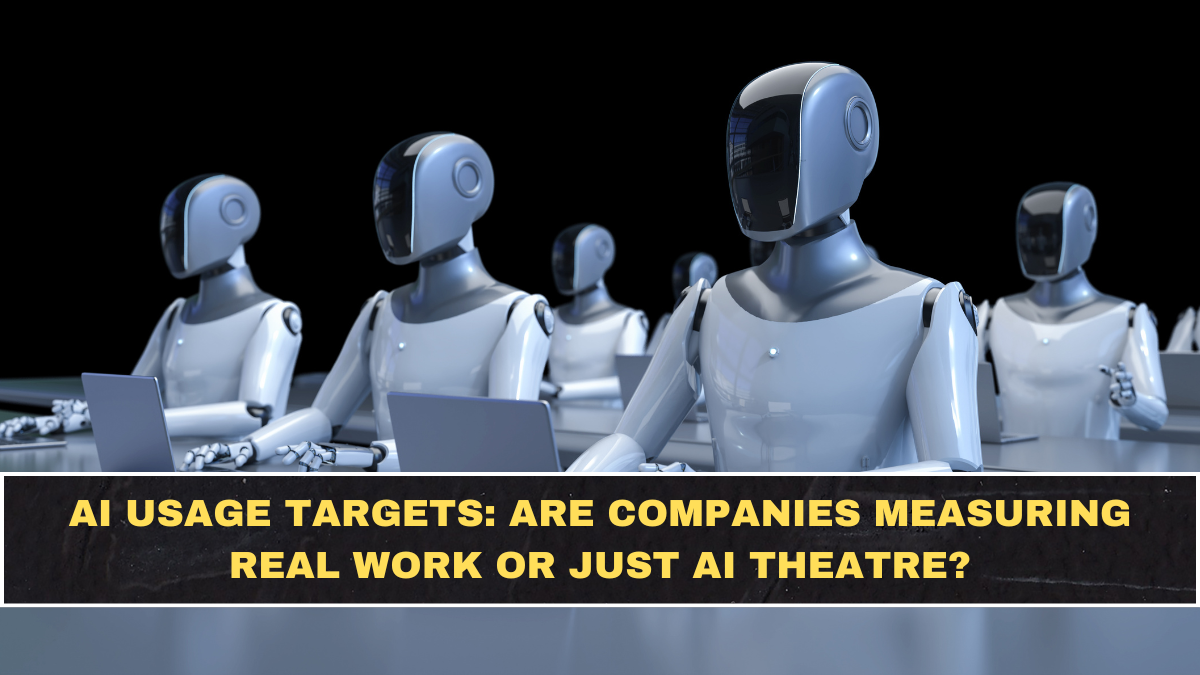
Companies are pushing employees to use AI because leaders want proof that expensive AI investments are producing change. That pressure is understandable, but the mistake starts when usage itself becomes the main success metric. If workers know they are being measured on AI activity, they may start using tools for unnecessary tasks just to look modern, efficient or compliant.
This is where “AI transformation” can quietly become AI theatre. Microsoft’s 2026 Work Trend Index says the real question is whether organisations are built to capture value from AI, not merely whether workers are using it. The report is based on trillions of anonymised Microsoft 365 productivity signals and a survey of 20,000 AI-using workers across 10 countries.
What Are Companies Measuring Wrong?
The weakest metric is simple usage count. It tells managers that an employee opened an AI tool, generated prompts or consumed tokens, but it does not prove the work became better. A team can show high AI adoption while customer complaints, code defects, missed deadlines or decision quality remain unchanged.
KPMG’s reported internal AI dashboard shows why this debate is heating up. Outlook Business reported that KPMG introduced an internal dashboard to track employee AI usage, benchmark workers against peers and push a 75% usage target for many staff in its US advisory business. Employees also raised concerns about inaccurate tracking and inflated usage risks.
| Bad AI Metric | Why It Misleads? | Better Metric |
|---|---|---|
| Number of prompts | More prompts may mean confusion | Time saved per workflow |
| Token usage | High usage can be artificial | Quality improvement |
| Login frequency | Opening a tool proves nothing | Completed useful tasks |
| Peer ranking | Creates pressure to perform AI use | Business outcome change |
| AI adoption rate | Shows activity, not impact | Revenue, cost or error reduction |
Why Can Forced AI Adoption Backfire?
Forced AI adoption backfires because employees are not stupid. If leaders reward visible AI usage, workers will optimise for visible AI usage. That can lead to fake productivity, unnecessary prompting, automated noise and inflated dashboards that make executives feel successful while real output barely improves.
McKinsey’s 2025 State of AI survey makes the gap clear. It found that 88% of respondents said their organisations regularly use AI in at least one business function, but only about one-third said their companies had begun scaling AI programmes. The report also noted that only 39% reported EBIT impact at the enterprise level.
What Should Leaders Track Instead?
Leaders need to stop worshipping AI activity and start tracking work outcomes. AI is useful only when it reduces friction, improves decision-making, saves measurable time or raises quality. If a department uses AI heavily but still needs the same manual reviews, the same rework and the same escalation volume, the adoption number is mostly decoration.
Better metrics should include:
- Hours saved on repeated workflows
- Reduction in error rates or rework
- Faster customer response and resolution time
- Improved code quality or lower defect count
- Better sales conversion or lead qualification
- Higher employee satisfaction with actual workflow impact
- Clear risk controls for hallucination, privacy and compliance
Why Is Employee Trust Part Of The Metric?
Employee trust matters because AI measurement can quickly feel like surveillance. Reuters reported that Meta employees protested the installation of mouse-tracking software, with some workers seeing it as part of the company’s AI-driven restructuring and automation efforts. Meta defended the tracking by saying models need real examples of how people use computers to build agents for everyday tasks.
This is a warning for every company. If employees believe AI tracking is really a way to monitor, rank or replace them, they will not use AI honestly. They will either resist it, game it or hide their real concerns. None of those behaviours help productivity.
Is AI Theatre Already Happening?
Yes, and the signs are obvious. When companies celebrate dashboards before proving outcomes, they are already drifting into AI theatre. A team may appear advanced because it has high AI usage, but if the actual work process is unchanged, the organisation is basically measuring noise.
The brutal truth is that many leaders want AI success stories faster than their workflows can produce them. That creates pressure to show numbers, and bad numbers are easy to manufacture. A company can force adoption targets in weeks, but real transformation requires process redesign, training, governance and accountability.
Conclusion: What Is The Real Lesson?
AI usage targets can help companies encourage adoption, but they become dangerous when they replace real productivity measurement. Counting prompts, logins or token usage is easy, but it does not prove business value. The smarter question is not “How much AI did employees use?” but “What work became faster, better or cheaper because of AI?”
Companies that confuse activity with impact will create fake productivity and employee resentment. Companies that measure workflow improvement, quality, risk and customer outcomes will actually benefit. AI is not magic. If your metrics are lazy, your AI transformation will be lazy too.
FAQs
What Are AI Workplace Metrics?
AI workplace metrics are measurements companies use to track how employees use AI tools at work. These can include logins, prompt volume, token usage, task completion, time saved, quality improvement or business impact, depending on how mature the company’s measurement system is.
Why Are AI Usage Targets Controversial?
AI usage targets are controversial because they can pressure employees to use AI even when it is not needed. If companies reward usage instead of outcomes, workers may inflate AI activity without improving productivity, quality or customer results.
What Is AI Theatre?
AI theatre means pretending that AI adoption is successful because dashboards and usage numbers look impressive. In reality, the business may not be saving time, improving quality or creating measurable value from AI.
What Should Companies Measure Instead?
Companies should measure real work outcomes such as time saved, lower error rates, faster customer resolution, better code quality, revenue impact and employee workflow improvement. Usage data can be helpful, but it should never be treated as proof of productivity by itself.