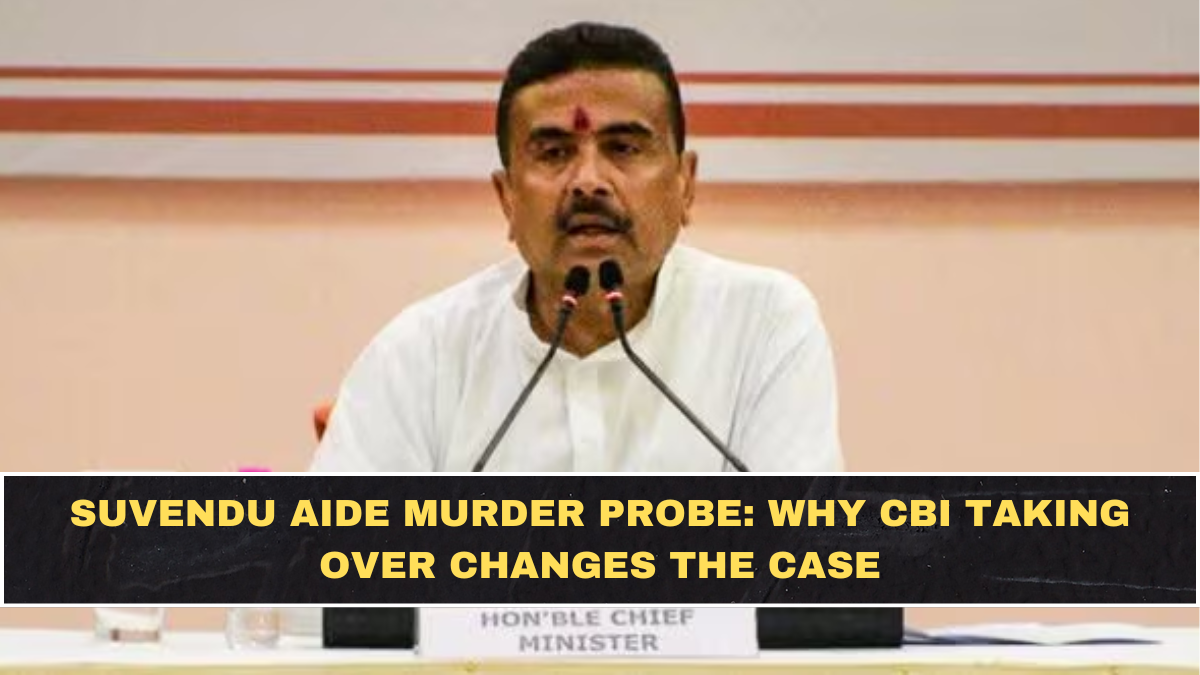
The murder of Chandranath Rath, personal aide to West Bengal Chief Minister Suvendu Adhikari, has taken a major turn after the Central Bureau of Investigation took over the case from Bengal Police. Rath was killed on May 6 in Madhyamgram, North 24 Parganas, just two days after the West Bengal Assembly election results were declared. The timing alone made the case politically explosive.
CBI taking over means this is no longer only a state police investigation. The agency has re-registered the FIR and will now conduct an independent probe, including fresh evidence review, witness examination and possible conspiracy links. India Today reported that the move followed a request from the state government and came after three arrests in the case.
What Do We Know So Far?
| Key Detail | Current Update | Why It Matters |
|---|---|---|
| Victim | Chandranath Rath | Close aide of Suvendu Adhikari |
| Location | Madhyamgram, North 24 Parganas | Politically sensitive Bengal district |
| Date | May 6, 2026 | Two days after Assembly results |
| Initial probe | Bengal Police/SIT | State-level investigation began first |
| Arrests | Three accused arrested | Probe had already moved interstate |
| New probe | CBI takes over | Case now gets central agency scrutiny |
Times of India reported that Rath was shot by gunmen about 170 metres from his home in Madhyamgram, and that police later arrested three people from Uttar Pradesh and Bihar. One of the accused was described as the alleged sharpshooter, though defence-side claims have already raised questions around the arrests.
Why Was The Case Handed To CBI?
The case was handed to CBI because of its political sensitivity, the interstate nature of the arrests and the need for a probe that can carry wider credibility. Deccan Herald, citing officials, reported that CBI action followed a request from the state government. That detail matters because it shows the transfer was not merely a demand from opposition voices; the state formally moved the case to the central agency.
The blunt truth is that Bengal’s political violence debate is so charged that any state-level probe quickly becomes politically contested. If Bengal Police investigates, one side may call it biased. If CBI investigates, another side may call it politically motivated. That is why evidence, not party slogans, must decide the case.
What Will CBI Investigate Now?
CBI’s job will not be limited to repeating what Bengal Police already found. The agency is expected to examine the murder trail independently, from motive and planning to weapon sourcing, travel routes, payment links and possible handlers. Indian Express reported that a seven-member SIT led by DIG Pankaj Kumar Singh has been formed to probe the Chandranath Rath murder case.
The investigation may focus on:
- Who planned the attack and who executed it.
- Whether the killing was political, personal or contract-based.
- How the accused travelled across states before and after the murder.
- Whether payment trails, phones or UPI transactions link the suspects.
- Whether there were local handlers in Bengal.
- Whether the arrested accused acted alone or under instruction.
Why Are The Arrests Already Controversial?
The arrests have already become controversial because families and lawyers of some accused have challenged the police version. Times of India reported that the mother of alleged sharpshooter Raj Singh claimed he was in Lucknow and Ayodhya with family members on May 6, and asked authorities to check CCTV footage and wedding videos.
This does not prove innocence, but it does prove why the CBI probe needs to be careful. In a politically sensitive murder case, weak evidence or rushed arrests can damage the case badly. If the accused are guilty, the agency must prove it cleanly. If someone was wrongly picked up, that must also come out.
Why Is Bengal Politics So Heated?
Bengal politics is heated because violence after elections has become a recurring and deeply polarising issue. Every killing linked to political workers or aides quickly becomes a battle between ruling and opposition narratives. In this case, Rath’s proximity to Suvendu Adhikari makes the murder far more sensitive than a routine crime report.
The danger is that political parties may use the murder to score points before the facts are fully established. That helps nobody. It can pressure investigators, inflame supporters and reduce a serious criminal case into slogan warfare. The focus should remain on who killed Rath, who ordered it and why.
What Happens Next?
The next phase will decide whether the case becomes stronger or messier. CBI will likely collect the original case files, examine forensic evidence, question accused persons, verify CCTV and digital trails, and reconstruct the attack route. It may also revisit the crime scene and speak to Rath’s family, political colleagues and local witnesses.
Key developments to watch are:
- Whether CBI confirms or challenges Bengal Police’s arrest theory.
- Whether digital evidence supports the interstate conspiracy angle.
- Whether any political motive is proven through evidence.
- Whether more arrests happen after call-data and payment analysis.
- Whether the alleged sharpshooter’s alibi claim is verified.
- Whether chargesheet findings reveal a larger network.
Conclusion: Why This Case Can’t Be Mishandled?
The Chandranath Rath murder case is now bigger than one crime file. Because the victim was close to Suvendu Adhikari and the killing happened immediately after election results, the case sits at the centre of Bengal’s political violence debate. CBI taking over changes the scale of investigation and raises public expectations for a clearer, more credible probe.
But the real test is not which agency handles the case. The real test is whether the evidence holds. If CBI can establish motive, execution and conspiracy without political noise drowning the facts, the probe will matter. If it becomes another partisan blame game, Rath’s murder will become one more unresolved wound in Bengal politics.
FAQs?
Who Was Chandranath Rath?
Chandranath Rath was a close aide and personal assistant of West Bengal Chief Minister Suvendu Adhikari. He was killed in Madhyamgram, North 24 Parganas, on May 6, 2026, shortly after the Assembly election results.
Why Did CBI Take Over The Case?
CBI took over after the state government requested a central probe. The case is politically sensitive, involved interstate arrests and has triggered major debate around post-election violence in Bengal.
How Many People Have Been Arrested?
Three people have reportedly been arrested from Uttar Pradesh and Bihar in connection with the case. One was described in reports as an alleged sharpshooter, though defence-side claims have questioned parts of the police version.
What Will CBI Check First?
CBI is expected to examine the original FIR, crime-scene evidence, CCTV footage, digital records, travel routes, payment trails and the role of any possible handlers. The agency will also have to verify claims made by the accused and their families.