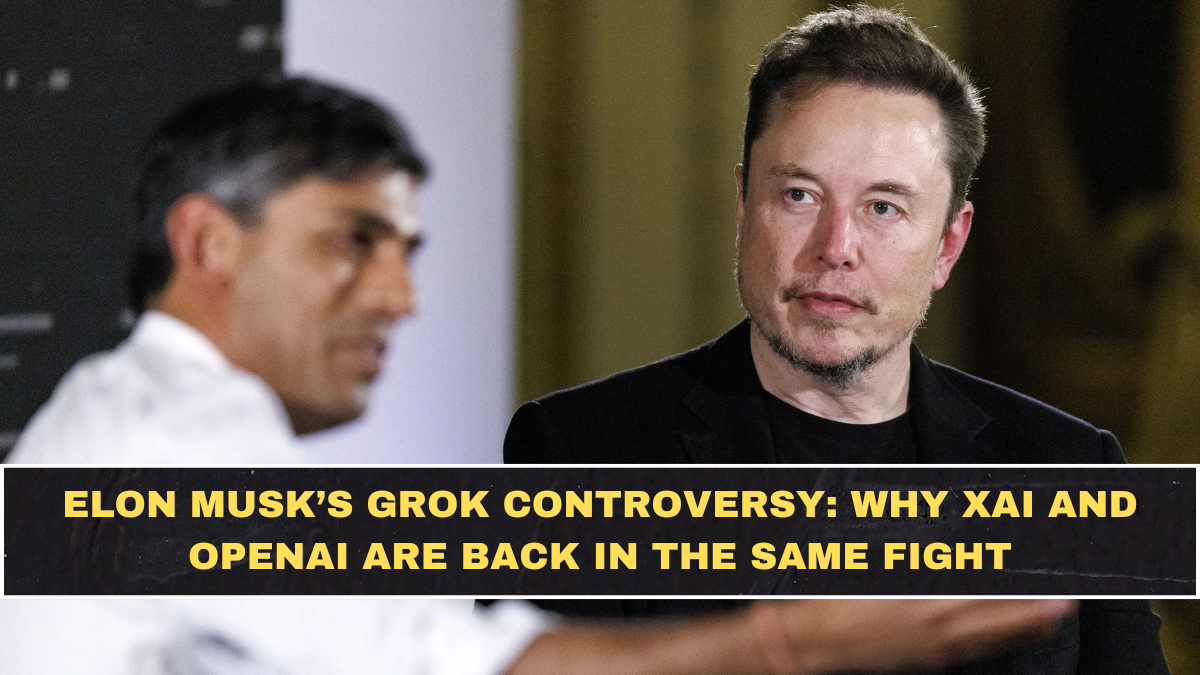
Elon Musk, xAI, Grok and OpenAI are back in headlines because two separate but connected issues are moving together. The first is Musk’s lawsuit against OpenAI, Sam Altman, Greg Brockman and Microsoft over OpenAI’s shift away from its original nonprofit structure. The second is Musk’s court testimony that xAI used OpenAI’s models while training Grok, which has raised fresh questions around AI model distillation and competitor data use.
Reuters reported that Musk testified OpenAI was his idea and claimed it was created as a nonprofit to advance artificial intelligence for public benefit. OpenAI’s legal team argued that Musk’s case is driven by control and profit motives, and said OpenAI’s for-profit structure was needed to compete with rivals such as Google DeepMind. This is why the fight is not just personal drama; it is about how powerful AI companies are built, funded and controlled.
What Did Musk Say About Grok Being Trained On OpenAI Models?
The Verge reported that Musk confirmed in court that xAI used OpenAI’s models while training Grok. When asked whether xAI had distilled OpenAI’s models, Musk reportedly answered “partly” and described model distillation as a standard industry practice. That answer matters because distillation is common in AI, but using a competitor’s model without permission can create legal and ethical controversy.
TechCrunch also reported that Musk testified xAI trained Grok on OpenAI models during the trial involving OpenAI, Altman and Brockman. The controversy is serious because Musk has repeatedly criticised OpenAI’s direction while his own AI company is now accused, through testimony, of relying partly on OpenAI model outputs for Grok training. That weakens any simple “good side versus bad side” reading of the dispute.
What Are The Key Facts In Simple Form?
| Issue | Verified Detail | Why It Matters |
|---|---|---|
| Main lawsuit | Musk is suing OpenAI, Sam Altman, Greg Brockman and Microsoft | The case challenges OpenAI’s current structure |
| Musk’s claim | He says OpenAI was created as a nonprofit for public benefit | This is the core of his legal argument |
| OpenAI’s defence | OpenAI argues Musk wanted control and profit | This directly challenges Musk’s motive |
| Grok training claim | Musk said xAI partly used OpenAI models | Raises distillation and competitor-use questions |
| Model distillation | One AI model transfers knowledge to another | Common practice, but legally sensitive with rivals |
| xAI product involved | Grok | Musk’s main AI chatbot competitor to ChatGPT |
This table shows why the story is bigger than one courtroom quote. Musk is accusing OpenAI of betraying its founding mission, while also admitting that his own AI company used OpenAI models partly in Grok training. That creates a difficult public argument for Musk because the controversy now involves both OpenAI’s governance and xAI’s training methods.
Why Is Model Distillation Such A Big Issue?
Model distillation is a technique where a smaller or newer AI model learns from the behaviour of a larger or stronger model. In normal internal use, companies may use distillation to make models faster, cheaper or more efficient. The problem begins when one company allegedly uses a competitor’s model outputs to train its own rival system without clear permission.
The Verge noted that companies such as OpenAI, Anthropic and Google have raised concerns about unauthorised distillation, especially involving rival AI firms. This is why Musk’s “partly” answer matters. It is not just a technical detail for engineers; it is a business and legal issue around intellectual property, fair competition and whether AI companies are quietly learning from each other’s most expensive systems.
Why Is Musk Fighting OpenAI In Court?
Musk’s legal fight focuses on OpenAI’s move from a nonprofit-focused mission to a structure involving commercial funding and Microsoft’s major investment. Reuters reported that Musk accuses OpenAI, Altman, Brockman and Microsoft of breaching the charity’s mission by turning the organisation into a profit-driven company. He is seeking damages and wants OpenAI’s nonprofit status restored.
OpenAI’s side has pushed back strongly. Reuters reported that OpenAI’s legal team argued Musk is suing only after failing to take leadership of the organisation. They also defended the for-profit entity as necessary because building competitive AI systems requires large amounts of capital, infrastructure and talent. This is the central clash: Musk frames it as a mission betrayal, while OpenAI frames it as necessary evolution.
Why Does This Matter For The AI Industry?
This case matters because OpenAI and xAI are not small startups arguing over branding. They are part of the global race to build frontier AI systems that affect search, coding, customer support, education, creative work, enterprise tools and automation. When companies at this level fight over model training, nonprofit control and commercial power, the outcome can influence how future AI firms are structured and regulated.
The Grok training admission also exposes a harsh truth about the AI race. Even companies that publicly attack each other may still learn from each other’s systems, directly or indirectly. That is why regulators, investors and users are watching this fight closely: it touches governance, transparency, copyright, competition and safety in one messy dispute.
What Should Readers Not Misunderstand?
Readers should not assume that “model distillation” automatically means illegal conduct. Distillation can be a legitimate technical method when used properly. The controversy is about whether a company used a rival’s models in a way that violates rules, contracts, platform policies or broader intellectual-property expectations. That difference is important because technical practice and legal permission are not the same thing.
Readers should also avoid treating Musk’s lawsuit as already proven. Reuters reporting shows both sides making sharply different claims in court. Musk says OpenAI abandoned its founding mission, while OpenAI says Musk’s case is about control and profit after he failed to lead the company. The final legal outcome depends on court findings, not social media arguments.
What Is The Conclusion?
The Elon Musk Grok OpenAI controversy matters because it combines two explosive issues: OpenAI’s legal structure and xAI’s use of OpenAI models for Grok training. Musk is suing OpenAI over its shift away from nonprofit origins, but he also testified that xAI partly used OpenAI models while training Grok. Those two facts make this one of the most important AI disputes of 2026.
The clean takeaway is this: Musk is challenging OpenAI’s mission, while xAI is now facing questions about its own AI-building methods. This fight is not only about Musk versus Altman. It is about how AI models are trained, who controls frontier AI companies, and whether the industry’s biggest players follow the standards they demand from others.
FAQs
What Did Elon Musk Say About xAI Training Grok?
Musk reportedly confirmed in court that xAI partly used OpenAI’s models while training Grok. The Verge reported that he described model distillation as a standard industry practice, but the admission still raised questions because OpenAI is a direct competitor.
Why Is Elon Musk Suing OpenAI?
Musk is suing OpenAI, Sam Altman, Greg Brockman and Microsoft over claims that OpenAI breached its original nonprofit mission by becoming more commercially focused. Reuters reported that OpenAI’s legal team denies Musk’s framing and argues his case is about control and profit.
Is Model Distillation Always Illegal?
No, model distillation is not automatically illegal. It is a common AI technique where one model transfers knowledge to another. The legal and ethical problem appears when a company uses a competitor’s model without permission or in a way that violates rules, agreements or fair-use boundaries.