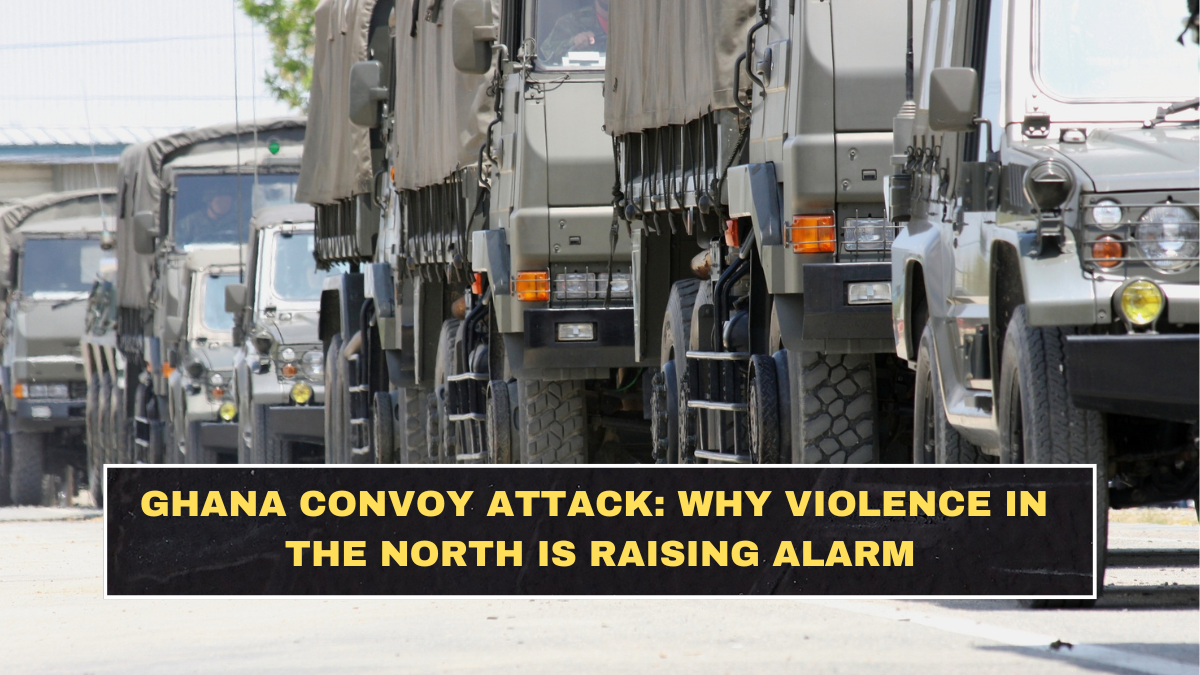
A Ghana Armed Forces escort convoy carrying civilians came under fire in Binduri, in Ghana’s Upper East Region, killing three civilians and injuring one person. The convoy was reportedly transporting about 140 civilians from Bawku toward Bolgatanga when unidentified assailants attacked it. The military said it repelled the attack and killed seven assailants during the exchange.
The attack is alarming because the convoy was not simply a military patrol. It was protecting civilians moving through a tense and insecure area. When armed groups target escorted civilian movement, it signals a deeper security breakdown. It means people are not only unsafe in their communities, but also at risk when they try to travel under official protection.
Why Is Binduri Becoming A Security Concern?
Binduri sits in Ghana’s Upper East Region, close to areas affected by long-running tensions around Bawku. The broader Bawku conflict has been linked to chieftaincy disputes, local violence, armed attacks, and heavy security deployment. This latest convoy attack shows that the instability is not staying contained inside one town. It is spilling into movement routes, nearby communities, and civilian protection operations.
Local Ghanaian media reported that the convoy was travelling from Bawku to Bolgatanga when it came under heavy gunfire from unidentified attackers. The Ghana Armed Forces later said weapons and ammunition were recovered, including a locally made weapon and a G3 rifle, while suspects were arrested after follow-up operations.
| Key Detail | What Is Known So Far |
|---|---|
| Location | Binduri, Upper East Region, Ghana |
| Convoy route | Bawku to Bolgatanga |
| Civilians protected | About 140 people |
| Civilian deaths | Three killed |
| Injuries | One person injured |
| Assailants killed | Seven, according to the military |
| Suspects arrested | Reports range from 10 initially to 21 later |
Why Were Civilians Moving With A Military Escort?
Civilians were likely moving with a military escort because the route was considered unsafe. In conflict-affected areas, convoys are sometimes used when people need to travel through dangerous zones for relocation, safety, trade, medical reasons, or family movement. The fact that about 140 civilians were escorted shows that authorities already knew the security risk was serious.
This is the part many casual readers miss. A military escort is not a sign that everything is under control. It is usually a sign that normal civilian movement has already become too dangerous. If even an escorted convoy can be attacked, then the threat level is higher than ordinary crime or random violence.
Who Carried Out The Attack?
The attackers have not been publicly identified with certainty. Reuters reported that the convoy came under fire from assailants and that Ghana’s military killed seven of them while repelling the attack. Ghanaian outlets also described them as unidentified or unknown assailants, which means officials have not yet clearly linked the attack to one named group.
That uncertainty matters. Rushing to blame one side without evidence would be irresponsible. Ghana’s northern security environment includes local disputes, criminal violence, armed networks, and regional insecurity spilling across West Africa. Until investigations are complete, the safest conclusion is that this was a serious armed attack in a volatile area, not a fully explained incident.
Why Is Northern Ghana Under More Pressure?
Northern Ghana is under pressure because instability across West Africa has expanded over the past decade. Countries such as Burkina Faso, Mali, and Niger have faced jihadist violence, coups, armed-group expansion, and cross-border security threats. Ghana has been more stable than many neighbours, but its northern border areas remain exposed to regional insecurity.
The Binduri attack does not automatically mean Ghana is facing the same level of insurgency as Sahel countries. That would be an overstatement. But it does show why security officials are worried. Local conflicts can become more dangerous when weapons circulate, communities lose trust, and armed actors exploit fragile areas.
Why Does The Bawku Area Matter?
The Bawku area matters because it has been one of Ghana’s most sensitive internal-security flashpoints. Long-running tensions have repeatedly led to violence, curfews, arrests, and military deployments. When violence affects nearby towns and road movements, the crisis becomes harder to manage. It is no longer only about one dispute; it becomes a regional safety problem.
The latest attack also damages public confidence. If civilians believe they cannot travel safely even with soldiers nearby, fear spreads quickly. That can reduce economic activity, disrupt schooling, affect healthcare access, and push more people to avoid roads, markets, and normal daily movement.
What Does This Mean For Ghana’s Security Forces?
For Ghana’s security forces, the attack creates a difficult test. They must protect civilians, prevent revenge violence, investigate suspects, and avoid actions that worsen local tensions. Heavy security responses can restore order, but they can also create resentment if communities feel targeted unfairly. That balance is hard and extremely important.
Citi Newsroom reported that arrests linked to the attack later rose to 21, according to the Acting Director General of Public Relations for the Ghana Armed Forces. The report said investigations were still active and suspects were assisting police. This shows the case is evolving, and final responsibility may take time to establish.
Could This Violence Spread Further?
Yes, it could spread if it is not contained carefully. Attacks on civilians can trigger fear, retaliation, rumours, and community suspicion. In tense areas, one convoy attack can quickly become a wider cycle of blame. That is why transparent investigation and clear communication are essential.
However, Ghana still has stronger state institutions than many crisis-hit countries in the region. That gives it a better chance of containing violence if authorities act quickly and fairly. The real danger is complacency. Ghana cannot assume its national stability automatically protects every border or conflict-prone district.
What Should Authorities Do Now?
Authorities need to do three things immediately. First, protect civilians moving through high-risk routes with better intelligence, not just armed escorts. Second, investigate the attack transparently and avoid premature blame. Third, address the underlying tensions that make areas like Bawku and Binduri vulnerable to repeated violence.
Military force may stop attackers in the moment, but it cannot solve the deeper crisis alone. If communities remain divided, weapons remain available, and trust stays broken, convoy escorts will become a symptom of failure rather than a solution. Ghana needs both security enforcement and serious conflict-resolution work.
Conclusion
The Ghana military convoy attack in Binduri is a serious warning. Three civilians were killed while travelling under military escort, and seven assailants were reportedly killed after the army repelled the attack. The convoy was protecting about 140 civilians, which shows how unsafe movement has become in parts of the Upper East Region.
The blunt truth is that Ghana cannot treat this as just another isolated attack. When civilians need military escorts and still get attacked, the security situation is already fragile. The government’s challenge now is not only to arrest suspects, but to stop northern violence from becoming a deeper, wider crisis.
FAQs
What happened in the Ghana convoy attack?
A Ghana Armed Forces escort convoy carrying about 140 civilians from Bawku toward Bolgatanga was attacked near Binduri. Three civilians were killed, one person was injured, and the military said seven assailants were killed.
Where is Binduri located?
Binduri is in Ghana’s Upper East Region, near the conflict-sensitive Bawku area. The region has faced security concerns linked to local violence, armed attacks, and wider instability in northern Ghana.
Who attacked the convoy?
The attackers have not been officially identified with certainty. Reports describe them as unidentified assailants, and Ghanaian authorities have arrested suspects while investigations continue.
Why is this attack important?
The attack is important because it targeted civilians travelling under military protection. That raises serious concerns about road safety, civilian movement, and the strength of armed groups or attackers in northern Ghana.