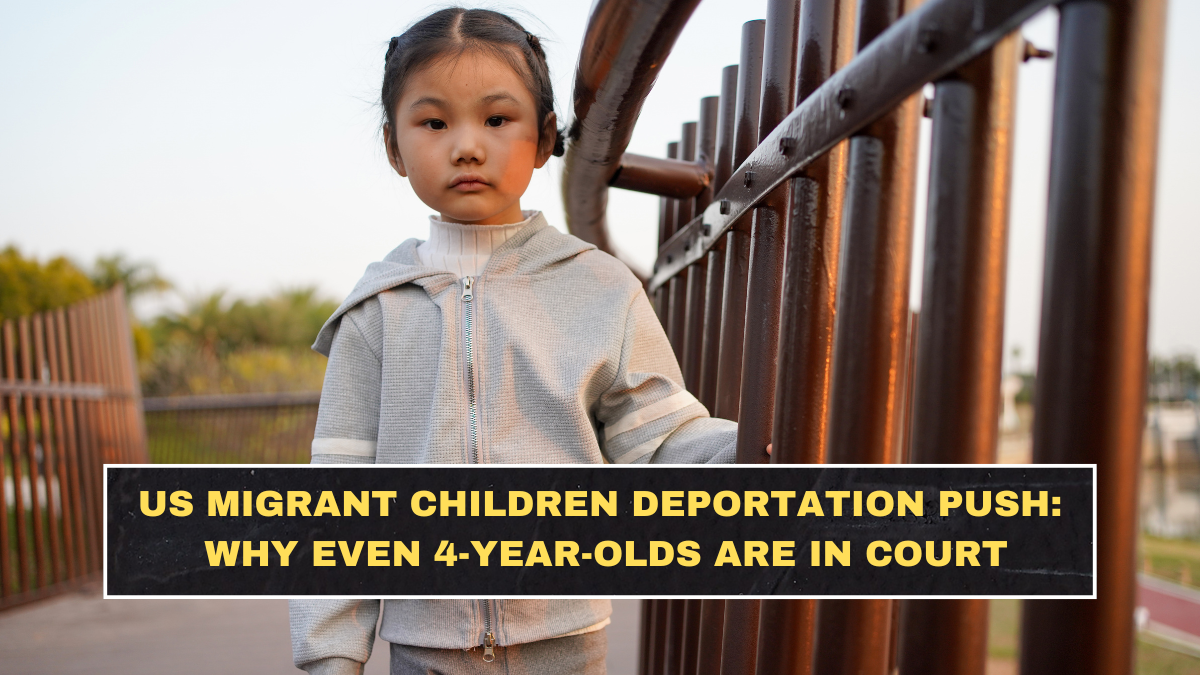
The US government is reportedly accelerating deportation hearings for migrant children in custody, moving some court dates forward by weeks or even months. According to Reuters, citing CNN, children as young as four may be required to appear repeatedly in immigration court, often without legal representation. That one detail is why this story has exploded into a legal, political, and moral controversy.
The Trump administration’s argument is that faster hearings can disrupt trafficking networks and return children to safer environments more quickly. The Department of Health and Human Services said many children in custody are vulnerable to trafficking, and some were smuggled by cartels. But critics argue that rushing children through legal proceedings risks turning due process into theatre, especially when the child is too young to understand what is happening.

What Does It Mean For A Child To Appear In Immigration Court?
Immigration court is not designed for preschool children. These hearings involve legal status, asylum claims, deportation orders, custody questions, trafficking concerns, and sometimes complex family histories. A four-year-old cannot meaningfully explain fear of return, understand legal rights, gather evidence, or challenge government claims. That is why lawyers and child-rights advocates say legal representation is not optional in these cases.
The US immigration system does not automatically guarantee government-funded lawyers for migrants in deportation proceedings, even for children. That creates a brutal gap: a child can face removal from the country while not having anyone legally trained to defend their case. For adults, that is already difficult. For a child, it can be impossible.
| Key Issue | Why It Matters |
|---|---|
| Fast-tracked hearings | Children may have less time to find legal help |
| Very young children | Some may not understand court proceedings |
| No guaranteed lawyer | Due process becomes weaker in practice |
| Trafficking concerns | Government says speed protects vulnerable children |
| Legal risk | Children may be deported without full case review |
Why Are Critics Calling This A Due Process Problem?
Critics say the problem is not only deportation itself. The problem is speed without protection. If a child’s hearing is moved up suddenly, lawyers may not have time to prepare, sponsors may not understand deadlines, and evidence may not be collected. In asylum or trafficking-related cases, missing one document or deadline can change a child’s entire future.
A federal court recently rejected a Trump administration effort to weaken long-standing protections for immigrant children, with immigrant-rights groups saying the ruling preserved decades-old safeguards. That context matters because the current fast-tracking push is happening while courts are already scrutinising how the administration handles children in immigration custody.
Why Does The Government Say It Is Necessary?
The government’s defence is that some children are being exploited by traffickers, smugglers, or unsafe sponsors. From that viewpoint, faster court action is meant to prevent children from staying in uncertain or dangerous situations for too long. Officials argue that quick decisions can help return children to safer environments and reduce cartel-linked abuse.
That argument cannot be dismissed entirely. Child trafficking is real, and some migrant children do face serious exploitation risks. But here is the uncomfortable part: a real problem does not automatically justify a reckless solution. If the process is too rushed, the government may end up deporting vulnerable children without properly identifying trafficking victims, asylum claims, family ties, or danger in their home countries.
Why Are Four-Year-Olds In Court So Shocking?
The image of a four-year-old in immigration court is shocking because it exposes the mismatch between legal procedure and childhood reality. A child that young may not be able to read, understand a judge, remember dates, describe trauma, or know why adults are asking questions. Yet the outcome can decide whether they stay in the US or are removed.
This is where the policy becomes morally explosive. The government may say it is following legal procedure, but procedure does not automatically equal fairness. If the person facing the system cannot understand the system, then the process needs extra safeguards. Without those safeguards, the court hearing becomes a formality, not justice.
How Does This Fit Into Trump’s Wider Immigration Crackdown?
This push fits into a wider Trump administration strategy of faster removals, stricter border controls, expanded detention, and reduced asylum access. AP reported that a federal appeals court recently ruled Trump’s asylum ban at the border illegal, saying the president could not override statutory asylum protections through unilateral action. That ruling shows how aggressively the administration has been testing the limits of immigration law.
Reuters also reported that a woman and her five children, aged five to eighteen, were released after what was described as the longest ICE detention of a family under Trump, following a judge’s order. That case shows the broader pressure around family detention, child custody, and immigration enforcement is not theoretical. It is already playing out in courts and detention centres.
What Are The Risks For Children If Hearings Move Too Fast?
The biggest risk is wrongful deportation or unsafe return. A child may have a valid asylum claim, may fear abuse, may have been trafficked, or may have family in the US who can provide safe care. If hearings move too quickly, these facts may never be properly presented. Once a child is deported, fixing a mistake becomes much harder.
There are also emotional and developmental risks. Immigration enforcement can create fear, instability, separation anxiety, and trauma for children. Reports on the wider crackdown have described young children becoming more fearful, clingy, and distressed when immigration enforcement affects families and caregivers. That does not decide the legal question, but it does show the human cost of turning children into fast-track case numbers.
What Should A Fairer Process Look Like?
A fairer process would still allow the government to investigate trafficking and unsafe sponsorship, but it would not rush children through court without support. Every child facing deportation should have legal representation, age-appropriate explanations, proper screening for trafficking and asylum claims, and enough time to gather evidence. Anything less is pretending a child can defend themselves against the state.
The government also needs better case management, not just faster deportation. If the concern is child safety, then the answer should include child-welfare experts, trauma-informed interviews, safe sponsor checks, and court oversight. Speed alone is not child protection. Sometimes speed is just efficiency without humanity.
Conclusion
The US push to accelerate deportation hearings for migrant children is one of the most controversial parts of the current immigration crackdown. The government says faster hearings can protect children from traffickers and unsafe conditions. Critics say the policy risks pushing vulnerable children, including very young children, through a legal system they cannot understand and often cannot navigate without lawyers.
The blunt truth is this: a four-year-old should not be expected to defend their future in court like an adult. If the US wants to remove children quickly, it must first prove the process is fair, careful, and genuinely protective. Otherwise, this is not child safety. It is deportation speed dressed up as protection.
FAQs
Why are migrant children appearing in US immigration court?
Migrant children may appear in immigration court when the government is deciding whether they can remain in the US or should be removed. Some children may have asylum claims, trafficking concerns, or family-based legal issues that require court review.
Are children guaranteed lawyers in deportation hearings?
No. Migrants in US immigration court, including children, are not automatically guaranteed government-funded lawyers. This is one of the biggest concerns because children may face deportation without proper legal help.
Why does the Trump administration want faster hearings?
The administration says faster hearings can help protect vulnerable children from trafficking networks and unsafe situations. Officials argue that moving cases quickly can return children to safer environments sooner.
Why are critics angry about this policy?
Critics argue that fast-tracking children’s cases can weaken due process. Very young children may not understand court, may lack lawyers, and may be deported before asylum, trafficking, or safety concerns are properly reviewed.