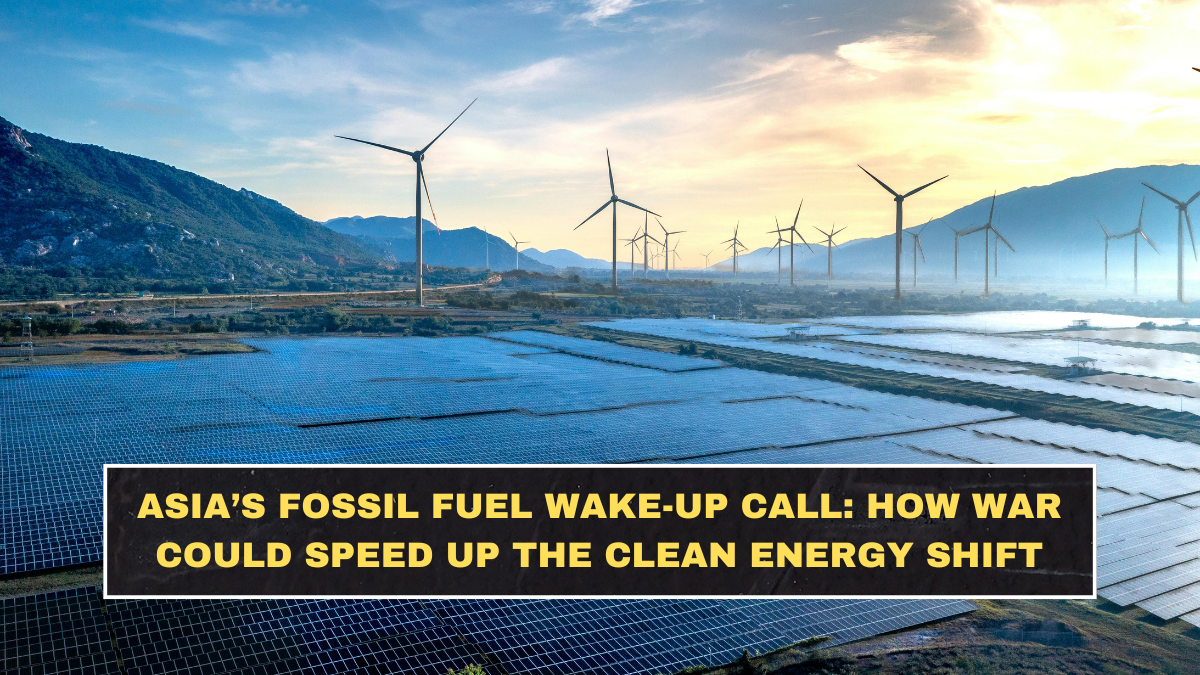
Asia is rethinking fossil fuels because the Iran war has exposed a hard truth: imported oil and LNG are no longer just energy sources; they are national security risks. Reuters reported that the closure of the Strait of Hormuz has reduced global crude oil and LNG supply, intensifying Asia’s push toward electrification, energy storage and cleaner transport. More than 80% of the crude that normally passes through Hormuz is headed for Asia, making the region highly exposed to any shock in the Gulf.
This is not happening because governments suddenly became climate saints. That would be naive. The real driver is pain: expensive fuel, volatile LNG, inflation, weaker currencies and pressure on households. Clean energy is becoming attractive not only because it cuts emissions, but because it reduces dependence on fuel routes that can be blocked by war, sanctions or naval conflict.
How Has The Iran War Exposed Asia’s Fossil Fuel Dependence?
The Iran war has exposed Asia’s dependence by showing how quickly a regional conflict can hit transport, electricity, trade and inflation across the continent. The Asian Development Bank cut its 2026 growth forecast for Asia and the Pacific from 5.1% to 4.7% and raised its inflation forecast from 3.6% to 5.2%, citing higher energy prices and trade disruption from the Middle East war.
That means energy security is no longer a separate policy issue. It is now linked directly to jobs, food prices, interest rates and political stability. When oil rises, truck costs rise. When LNG rises, electricity and industrial costs rise. When currencies weaken, imported energy becomes even more expensive. That is the loop Asia is now trying to escape.
| Pressure Point | What Asia Is Learning? |
|---|---|
| Oil imports | Imported crude can become expensive overnight |
| LNG supply | Gas-dependent power systems face price shocks |
| Transport fuel | Petrol and diesel inflation hits households fast |
| EV adoption | Electric two-wheelers and cars reduce oil dependence |
| Battery storage | Storage helps manage renewable power reliability |
| Solar and wind | Domestic electricity reduces exposure to fuel imports |
Why Could Electric Vehicles Grow Faster After This Crisis?
Electric vehicles could grow faster because fuel shocks make petrol and diesel vehicles more expensive to run. Reuters reported that the Iran war is helping accelerate Asia’s shift from fossil fuels to electrification, especially through two- and three-wheelers, which are widely used across the region. EV two- and three-wheeler sales are projected to grow around 30% annually, supported by cheaper models and lower operating costs.
This matters because Asia’s transport transition will not look exactly like Europe or the United States. In many countries, the first big shift may not be luxury electric cars. It may be electric scooters, delivery bikes, rickshaws, buses and small commercial vehicles. That is where fuel savings become immediate and visible for ordinary workers.
Why Are Vietnam And Thailand Important Examples?
Vietnam and Thailand are important because they show that EV growth is no longer only a China story. Reuters reported that Vietnam and Thailand have seen strong EV sales growth, with companies such as VinFast expanding across Asia. Less affluent countries are also adopting EVs because cheaper models and lower running costs make them practical during a fuel crisis.
This is the part policymakers should not miss. EV adoption does not require every household to buy an expensive car. The real breakthrough comes when electric mobility becomes cheaper for daily use than petrol mobility. Once that happens, the clean-energy transition stops being a moral lecture and starts becoming a household-budget decision.
Why Is Battery Storage Becoming So Important?
Battery energy storage is becoming important because renewables need backup. Solar and wind can cut fossil fuel dependence, but they are variable. Batteries help store power when generation is high and release it when demand rises. Reuters reported that battery energy storage system installations in Asia are forecast to increase ninefold by 2036, showing how fast the reliability side of the transition is growing.
Without storage, countries may still fall back on gas or coal when renewable generation dips. With storage, grids can handle more solar and wind without becoming unstable. That is why batteries are not a side detail. They are the bridge between cheap renewable generation and dependable electricity.
How Does Solar Help Countries Cut Fuel Imports?
Solar helps countries cut fuel imports because sunlight is domestic, while oil and LNG often come from unstable or expensive global markets. Reuters reported that Pakistan’s solar boom helped slash $12 billion in oil and gas imports over the four years to February 2026, according to CREA and Renewables First. Cheap solar power has also encouraged a shift from petrol to electric motorbikes.
That is exactly the kind of proof Asia needs. Solar is not just an environmental symbol. It can reduce import bills, protect currencies and cut exposure to war-driven energy shocks. Countries that still treat renewables as optional are ignoring the numbers. The smarter view is simple: every unit of domestic solar electricity is fuel you do not have to import.
Is China The Biggest Winner From Asia’s Energy Shift?
China could be one of the biggest winners because it dominates many clean-energy supply chains. Reuters commentary noted that Chinese manufacturers account for more than 70% of global battery installations, followed by Korean companies at around 15%. If Asia accelerates EVs, batteries and storage, China’s industrial advantage becomes even more powerful.
That creates a new dependency problem. Asia may reduce dependence on Middle East oil but increase dependence on Chinese batteries, solar components and EV supply chains. That does not mean the transition is bad. It means governments need diversification, local manufacturing, recycling, grid investment and smart trade policy. Swapping one dependency for another would be lazy strategy.
Will Asia Completely Move Away From Fossil Fuels Soon?
No, Asia will not fully move away from fossil fuels soon. That is fantasy. Many countries still depend on coal for power, oil for transport, gas for industry and LNG for electricity stability. Reuters noted that even as electrification accelerates, demand for some refined products such as naphtha and jet fuel may still rise.
The real shift is not an overnight fossil-fuel exit. It is a gradual reduction in vulnerability. More EVs reduce petrol demand. More solar reduces gas imports. More batteries reduce the need for backup fossil generation. More efficient grids reduce waste. Each step weakens the power of future oil and gas shocks.
What Should Asian Governments Do Next?
Asian governments need to stop treating clean energy as a climate department project and start treating it as national economic protection. That means faster EV charging networks, battery storage auctions, grid upgrades, public transport electrification, rooftop solar support and better financing for households and small businesses.
They also need to be honest about bottlenecks. EVs without charging are useless. Solar without grid upgrades gets wasted. Batteries without clear market rules do not scale fast enough. Domestic manufacturing without standards can create low-quality products. The transition will not happen properly through slogans. It needs boring, disciplined execution.
What Is The Bottom Line?
The Iran war has given Asia a brutal reminder that fossil fuel dependence is expensive, unstable and politically risky. Oil and LNG shocks are already hitting inflation, growth forecasts and household budgets. That pressure is now making EVs, solar, wind and battery storage look less like green luxury and more like survival infrastructure.
The blunt truth is that Asia should have moved faster years ago. But crisis often does what climate conferences cannot: it forces action. If governments use this moment properly, the war-driven energy shock could speed up a cleaner, more secure energy system. If they waste it, Asia will remain trapped every time a distant conflict blocks fuel routes.
FAQs
Why Is Asia Moving Faster Toward Clean Energy?
Asia is moving faster because the Iran war has raised oil and LNG supply risks, making imported fossil fuels more expensive and unreliable. Reuters reported that the conflict is accelerating Asia’s shift toward electrification and energy storage.
How Much Crude Through Hormuz Goes To Asia?
Reuters reported that more than 80% of the crude passing through the Strait of Hormuz is headed for Asia, which makes the region especially vulnerable to disruption.
How Is The Iran War Affecting Asia’s Economy?
The Asian Development Bank cut Asia-Pacific’s 2026 growth forecast from 5.1% to 4.7% and raised its inflation forecast from 3.6% to 5.2% because of higher energy prices and trade disruption.
Why Are Electric Two-Wheelers Important?
Electric two-wheelers are important because they are cheaper to run than petrol bikes and are widely used across Asia. Their growth can quickly reduce petrol demand for daily commuting and delivery work.
Will Asia Stop Using Fossil Fuels Soon?
No. Asia will still use coal, oil and gas for years, but the crisis can speed up the shift toward EVs, renewables and batteries, reducing future dependence on imported fuels.
Click here to know more