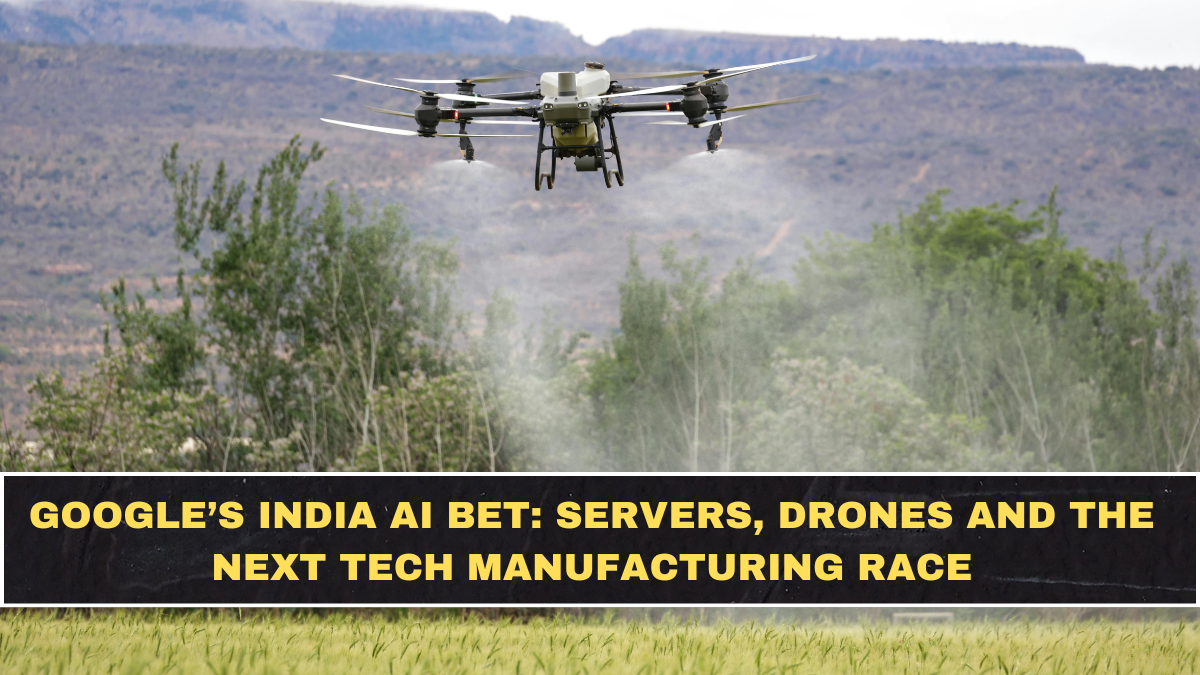
Google’s India AI investment story is getting attention because it is not only about software anymore. Union Minister Ashwini Vaishnaw said Google is exploring investments in India across AI infrastructure, along with manufacturing of servers and drones. That makes this a bigger story than another tech-office expansion because it touches data centres, hardware, electronics manufacturing and India’s AI ambitions.
The timing is important because AI needs massive computing power, and computing power needs servers, data centres, chips, energy and networks. India wants to move from being only a digital consumer market to becoming a serious AI infrastructure and manufacturing base. If Google actually expands in these areas, India could gain not just jobs, but deeper participation in the global AI supply chain.
What Exactly Is Google Exploring?
According to reports, Google is evaluating opportunities in AI infrastructure and local manufacturing of servers and drones after Vaishnaw’s meeting with company officials. This follows Google’s major AI hub push in Visakhapatnam, Andhra Pradesh, where the company has already announced a large-scale investment plan. That means this is not an isolated headline; it fits into a wider India AI infrastructure strategy.
The server angle is especially important because AI models require huge compute capacity. The drone angle is also interesting because drones connect to defence, logistics, agriculture, mapping and industrial monitoring. If India can build more of this locally, it reduces dependence on imported hardware and strengthens domestic tech manufacturing.
| Area | Why It Matters For India |
|---|---|
| AI Infrastructure | Builds compute capacity for AI tools and cloud services |
| Server Manufacturing | Supports data centres and reduces hardware dependence |
| Drone Manufacturing | Helps defence, logistics, farming and mapping sectors |
| Visakhapatnam AI Hub | Creates a large digital infrastructure base |
| Local Jobs | Can boost skilled manufacturing and engineering roles |
Why Is The Visakhapatnam Hub Important?
Google announced a $15 billion AI hub investment in Visakhapatnam over five years, including large-scale data-centre operations, energy infrastructure and subsea cable connectivity. AP reported that the project is meant to support digital transformation and strengthen India’s position in the AI race. That makes Vizag one of the most important locations in India’s emerging AI map.
This matters because AI infrastructure is not built only with apps and coders. It needs land, power, cooling, fibre networks, cloud systems and long-term capital. If India wants to compete seriously in AI, it cannot depend only on talent. It must also build the physical backbone that AI companies need to run advanced models.
Can This Make India A Tech Manufacturing Hub?
Yes, but only if India executes properly. Big announcements are easy; reliable manufacturing ecosystems are hard. Server and drone manufacturing will need component supply chains, skilled labour, quality control, export readiness, policy stability and fast approvals. Without those, India risks becoming an assembly location instead of a true manufacturing powerhouse.
The opportunity is still huge. India has already pushed electronics manufacturing through smartphones, semiconductors and production-linked incentives. If Google’s interest turns into real manufacturing commitments, it could attract suppliers, component makers and smaller tech firms into the same ecosystem. That is how one big investment can create a wider industrial cluster.
What Could Go Wrong?
The biggest risk is overhyping “exploring investments” as if money is already fully committed. Exploring means Google is evaluating options; it does not automatically mean every factory, server line or drone unit is confirmed. That distinction matters because headlines often turn early-stage interest into guaranteed success.
India also has to solve power reliability, regulatory delays, land issues, skilled workforce gaps and high-end component dependency. AI data centres consume serious energy, and manufacturing advanced servers is not the same as making basic electronics. If India ignores these hard problems, the Google story may become a PR win but not an industrial transformation.
Key risks to watch:
- Policy delays: Slow clearances can weaken investor confidence.
- Power demand: AI data centres need reliable and scalable electricity.
- Supply chain gaps: Servers need advanced components, not just assembly lines.
- Talent shortage: Hardware, AI infra and drone engineering need specialised skills.
- Execution gap: Announcements must turn into factories, jobs and exports.
Conclusion?
Google’s India AI bet can become a major turning point if it moves from exploration to execution. AI infrastructure, servers and drones are not small side businesses; they are strategic sectors that can shape India’s role in the next technology race. The Visakhapatnam AI hub already shows that Google is treating India as more than just a user market.
But the honest view is this: India should not celebrate too early. The real victory will come only when investment becomes operational infrastructure, manufacturing lines, skilled jobs and export capacity. If that happens, Google’s India push could strengthen both India’s AI future and its tech manufacturing ambitions.
FAQs?
What Is Google Planning In India?
Google is exploring investments in India across AI infrastructure, server manufacturing and drone manufacturing. The update was shared by Union Minister Ashwini Vaishnaw after a meeting with Google officials. The move also follows Google’s large AI hub investment plan in Visakhapatnam.
Why Are Servers Important For AI?
Servers are important because AI models need massive computing power to train, run and serve users. Without strong server and data-centre infrastructure, AI companies cannot scale efficiently. Local server manufacturing can also reduce dependence on imported hardware.
Why Is Google’s Visakhapatnam AI Hub Important?
The Visakhapatnam AI hub is important because Google has announced a $15 billion investment plan there over five years. The project includes data-centre operations, energy infrastructure and network connectivity. It can become a key part of India’s AI infrastructure base.
Can This Create Jobs In India?
Yes, it can create jobs if the investment becomes real manufacturing and infrastructure activity. Potential roles may emerge in data centres, hardware assembly, drone engineering, cloud operations, logistics and maintenance. However, the quality of jobs will depend on how deeply India participates in the supply chain.