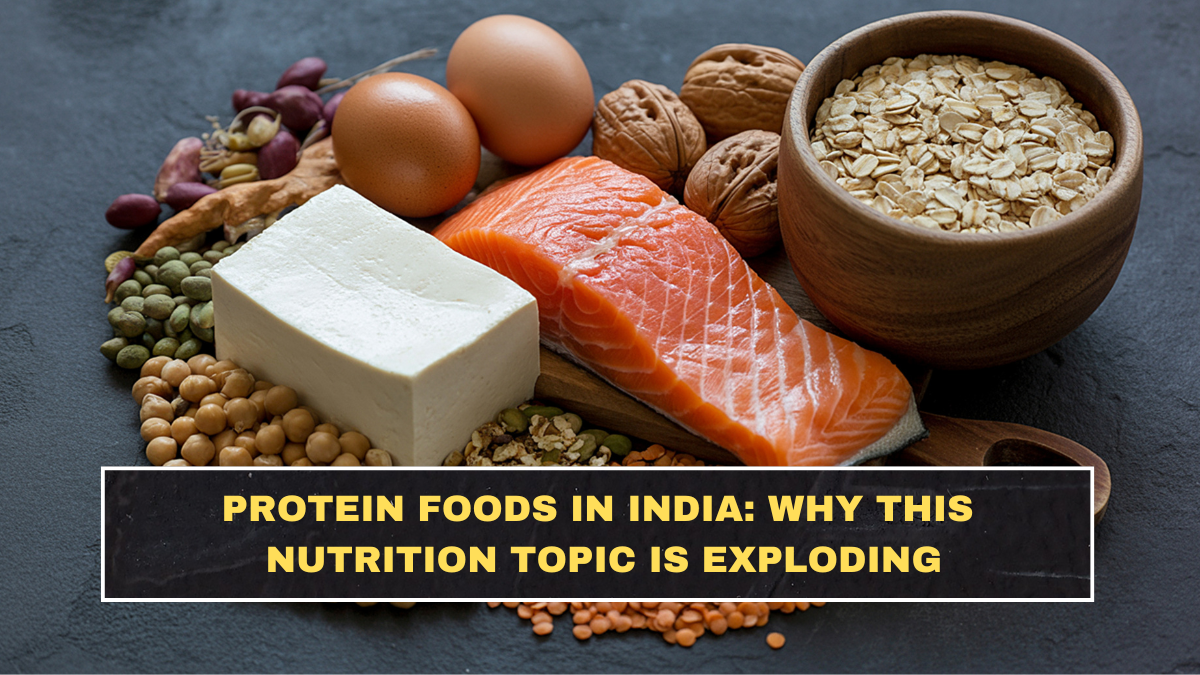
Protein foods are blowing up in India because people are finally paying attention to a problem that has been hiding in plain sight for years: many diets provide enough calories but not enough high-quality protein. ICMR-NIN’s guidance puts the adult protein RDA at 0.83 g per kg per day, and notes that for cereal-based diets with lower-quality protein, the requirement can be closer to 1 g per kg per day. A newer CEEW analysis based on the 2023–24 NSSO household survey found that nearly half of India’s at-home protein intake now comes from cereals, while pulses contribute only about 11%, far below the NIN-recommended 19% share.
That is why this topic is exploding. People are not just chasing gym culture anymore. They are noticing low satiety, weak meal structure, and diets that rely too heavily on roti, rice, and snacks while underusing eggs, dairy, pulses, soy, fish, and meat. CEEW also found deep inequality inside the averages: the richest 10% consume about 1.5 times more protein than the poorest, and poorer households fall especially short on milk, eggs, fish, and meat.
Why Are Protein Foods in India Getting So Much Attention?
The demand is rising because the old Indian meal pattern is often carb-heavy and protein-light. CEEW’s 2025 analysis found average at-home protein intake at 55.6 g per day, but the bigger issue was protein quality, since cereals supply nearly 50% of that total despite poorer digestibility and amino acid balance than pulses, dairy, eggs, fish, and meat. That means many people are not starving for protein in a dramatic way, but they are still building weak diets around low-quality sources.
ICMR-NIN’s own dietary guidance also pushes variety for exactly this reason. The 2024 Dietary Guidelines advise including pulses, nuts, fish, milk, and eggs in the daily diet to ensure better protein intake instead of relying too heavily on one staple category. So the protein conversation is not just social media hype. It is a correction to how a lot of people have been eating.
Which Protein Foods in India Give the Best Value?
The best-value foods are the ones that are affordable, repeatable, and easy to fit into normal Indian meals. Eggs are still one of the easiest options, with about 6 to 7 g of protein per egg. Paneer typically gives around 18 to 21 g per 100 g, and soy chunks are far denser, often around 52 to 54 g per 100 g dry weight. Those numbers matter because they expose a common mistake: many people think one bowl of dal solves the whole protein problem, when in reality they often need stronger sources spread across the day.
Curd, milk, chana, rajma, moong, masoor, peanuts, chicken, fish, and Greek-style curd also matter because they help build total daily intake without forcing people into expensive “fitness foods.” CEEW’s data showing pulses under-consumed across states is a warning sign here. India does not need more protein marketing first. It needs better daily food combinations.
What Are the Most Practical Everyday Protein Foods in India?
A practical Indian protein strategy is boring, and that is exactly why it works. Use eggs at breakfast, curd or milk in one meal, dal or chana in another, and add paneer, soy, chicken, or fish where budget allows. Even one better protein source added to two or three meals changes the day more than one “high-protein” snack bar ever will. ICMR-NIN’s guidelines and CEEW’s findings both point in the same direction: diversify away from cereal dominance.
| Food | Typical Protein | Why It Works |
|---|---|---|
| 1 egg | 6–7 g | Cheap, fast, easy to repeat |
| Paneer, 100 g | 18–21 g | Strong vegetarian option |
| Soy chunks, 100 g dry | 52–54 g | Very high protein for the price |
| Curd, 100 g | about 3.5–5 g | Easy add-on with meals |
| Chickpeas, 1 cup | about 14–15 g | Good budget plant protein |
| Sprouted moong, 1 cup | about 14–16 g | Useful for breakfasts and salads |
These are not magic foods. They are just foods that actually move the needle if eaten consistently.
How Can People in India Raise Protein Without Making Diets Complicated?
The simplest fix is to stop building meals around starch alone. A breakfast of chai and biscuits is useless for protein. So is a lunch that is mostly rice with a thin dal and no substantial add-on. A better structure is eggs with toast or poha plus curd, chana chaat, paneer bhurji, soy paratha, dal with extra curd, or chicken and rice with a proper protein portion. Even Times of India’s recent food coverage showed soya-chana-dal paratha reaching roughly 12 to 14 g protein per serving, which is exactly the kind of practical upgrade people need more of.
The bigger mindset shift is this: protein should appear in every meal, not just dinner. That is where most Indian diets fail. People think one heavy protein meal later in the day compensates for weak breakfast and weak snacks. It usually does not.
What Do Most People Get Wrong About Protein in India?
The biggest mistake is assuming that a vegetarian diet automatically means protein deficiency or that a non-vegetarian diet automatically means protein sufficiency. Both are lazy assumptions. A vegetarian can do very well with paneer, curd, milk, soy, pulses, peanuts, and sprouts. A non-vegetarian can still eat badly if most meals are dominated by rice, roti, fried snacks, and tiny portions of protein. CEEW’s findings on cereal dependence make that brutally clear.
The second mistake is confusing “protein food” with expensive branded products. Most Indians do not need imported powder, protein chips, or overpriced bars to improve intake. They usually need better planning with ordinary foods already available in the market.
Conclusion?
Protein foods are exploding as a topic in India because the weakness in the average diet is becoming harder to ignore. The real issue is not just total grams. It is overdependence on cereals and underuse of better-quality sources like pulses, dairy, eggs, soy, fish, and meat. The smart move is not to chase trends blindly. It is to make each meal less carb-dominant and more balanced with repeatable, affordable protein foods that fit real Indian eating habits.
FAQs
Is protein deficiency a real issue in India?
Yes, but the bigger issue is often poor protein quality and poor meal balance rather than dramatic starvation-level deficiency. CEEW found nearly half of at-home protein intake comes from cereals, which is much higher than recommended.
What are the cheapest protein foods in India?
Eggs, chana, moong, masoor, curd, milk, peanuts, and soy chunks are among the most practical budget options. Soy chunks are especially dense, at roughly 52 to 54 g protein per 100 g dry weight.
Is paneer enough as a protein food?
Paneer helps a lot, with roughly 18 to 21 g protein per 100 g, but relying on only one source is weak planning. A better diet spreads protein across eggs, dairy, pulses, soy, or animal foods through the day.
How much protein do adults in India generally need?
ICMR-NIN says the adult RDA is 0.83 g per kg per day, and for cereal-based diets with lower-quality protein, the requirement can be closer to 1 g per kg per day.